thz-ntn - 100 GHz – 1 THz physics for NTN
Gallery
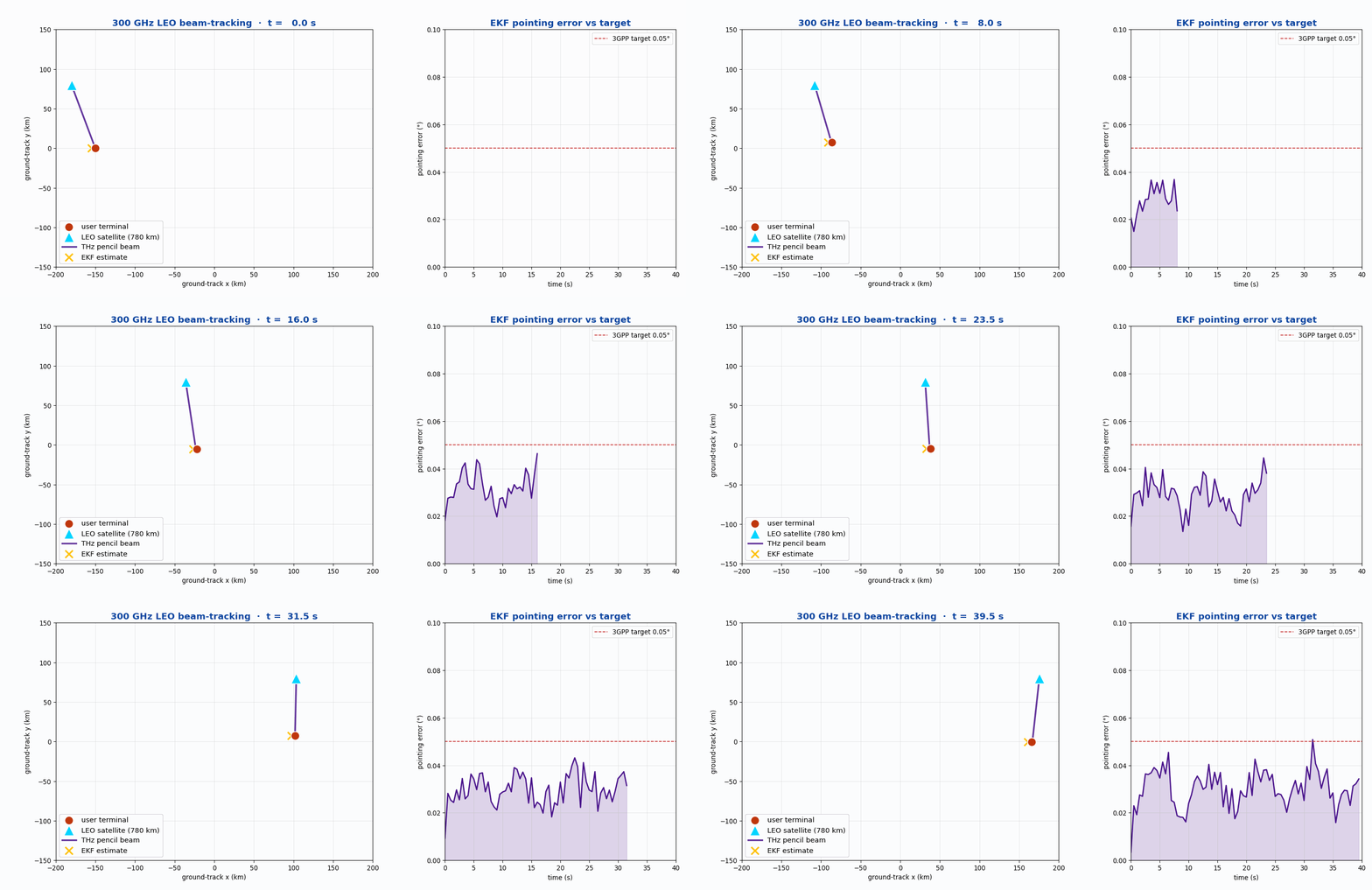
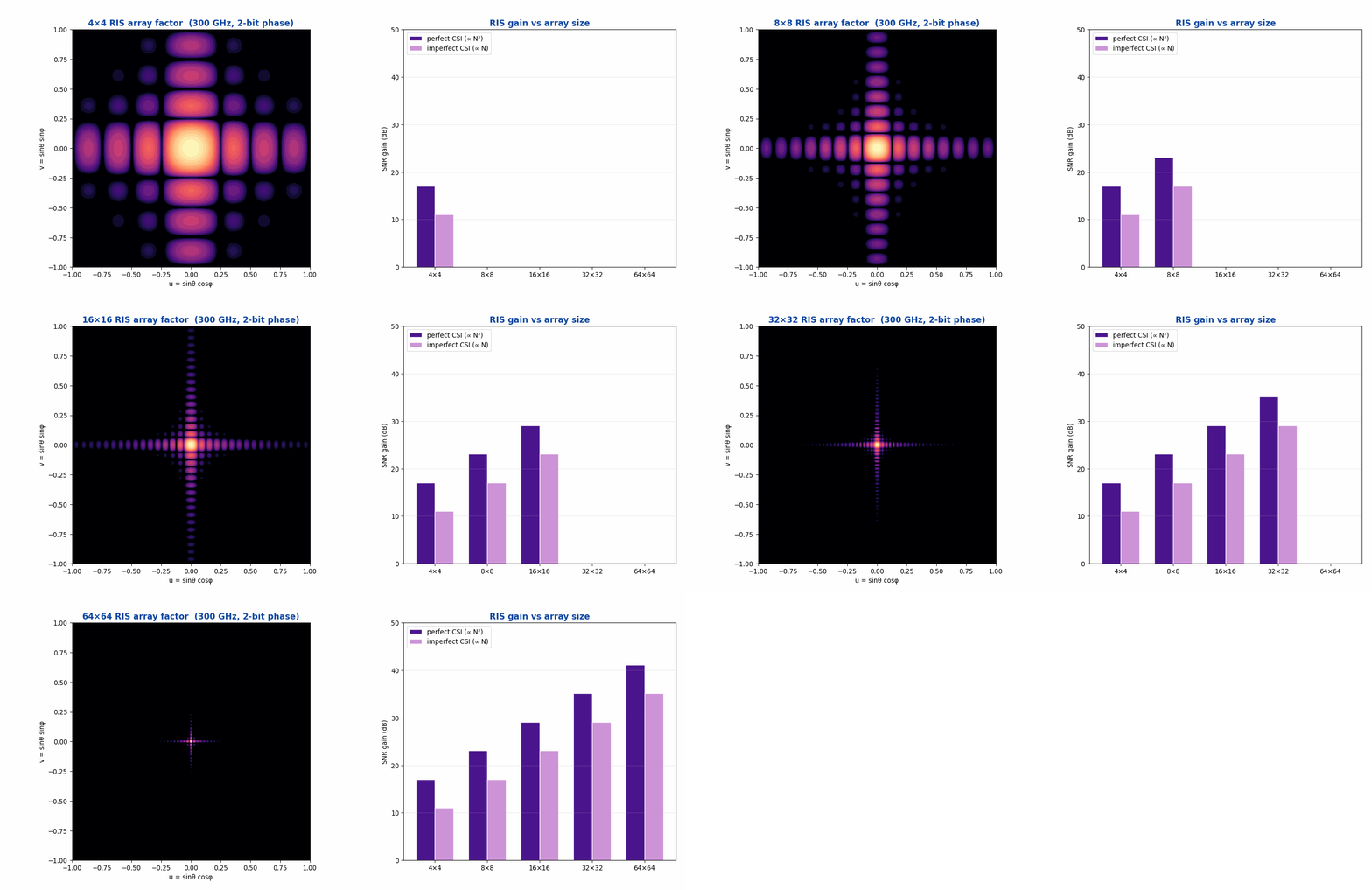
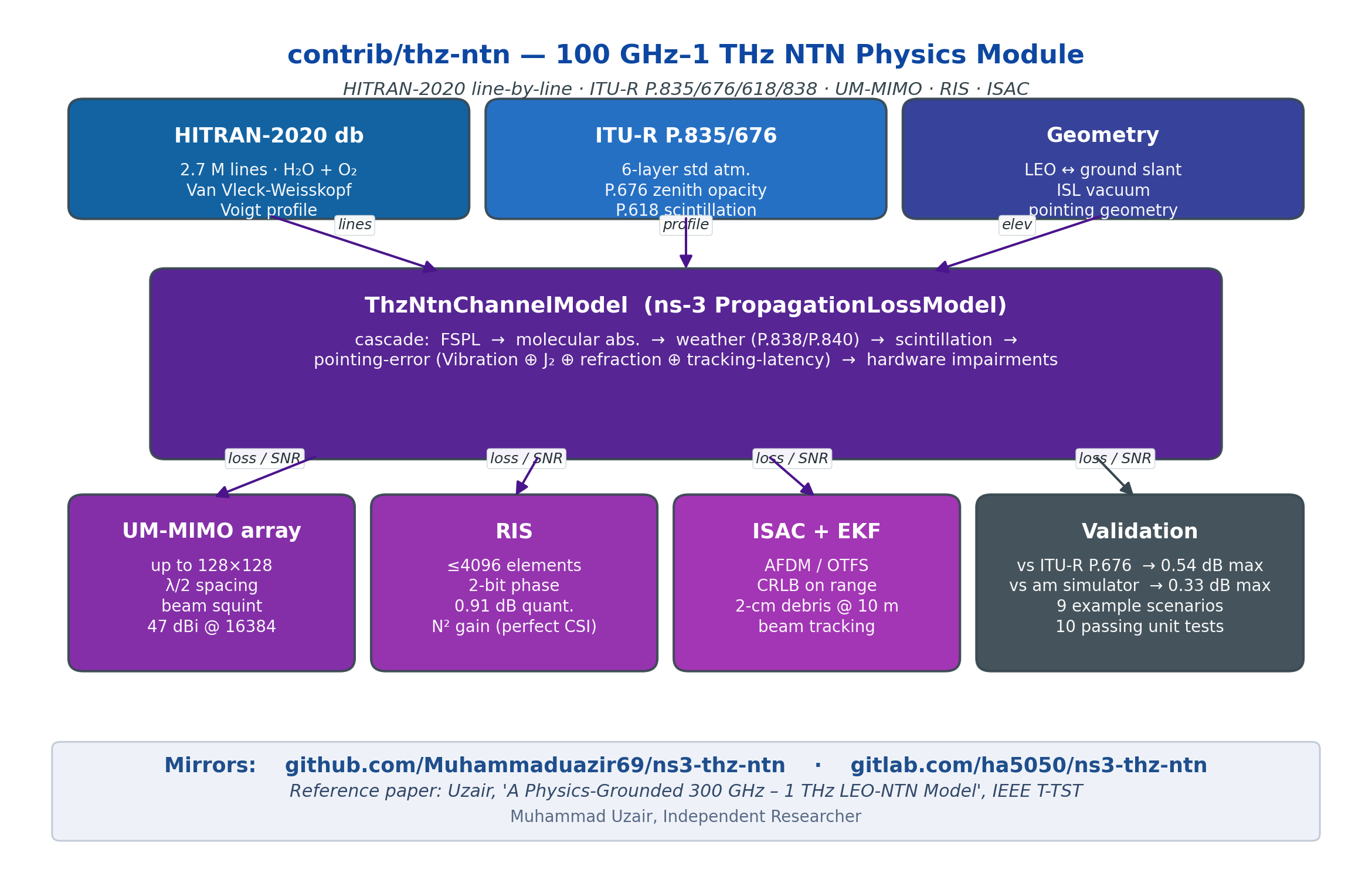
thz-ntn is the ns3-ntn-toolkit module that provides a physics-grounded 100 GHz to 1 THz (D-band and sub-THz) PHY layer for non-terrestrial links, cascading free-space path loss, ITU-R P.676-13 line-by-line molecular absorption, ITU-R weather and scintillation, alpha-mu fading, pointing error, and hardware impairments into a single composite channel. On top of that channel it adds ultra-massive MIMO arrays, reconfigurable intelligent surfaces, an ISAC sensing subsystem, and an EKF beam tracker, and re-homes the atmospheric loss as a real ns-3 PropagationLossModel so it attenuates actual packets on a live mmwave NR NTN spectrum channel and shows up in measured SINR / TBLER / goodput.
Why it matters. Terahertz and sub-THz NTN links live or die on molecular absorption, beam squint, and pointing stability, effects that closed-form path-loss models simply omit. thz-ntn is a physics-grounded sub-THz module for open ns-3: its channel is cross-validated against ITU-R P.676-13, P.618-13, and S. Paine's am atmospheric model, its scaling laws (radar range^4 SNR, RIS 20·log10(N) gain, UM-MIMO 10·log10(N) gain with 1/sqrt(N) beamwidth narrowing) are verified numerically correct, and its atmospheric loss is a chainable channel plug-in that attenuates real packets rather than a standalone spreadsheet.
What it simulates
- Composite THz channel cascade. Free-space path loss (
ThzNtnFreeSpaceLoss) with correct frequency/distance scaling; ITU-R P.676-13 Annex 1 line-by-line molecular absorption (ThzNtnMolecularAbsorption, the full 44 oxygen lines of Table 1 and 35 water-vapour lines of Table 2) over an ITU-R P.835 stratified atmosphere; weather attenuation (rain/fog/snow) per ITU-R P.838 / P.840; ITU-R P.618 scintillation (amplitude and phase, AR(1) time series); alpha-mu small-scale fading; composite pointing error (vibration, J2 perturbation, atmospheric refraction, tracking latency); and hardware impairments (PA, phase noise, ADC SQNR, I/Q imbalance). - Real channel plug-in.
ThzNtnPropagationLossModelre-homes the gaseous-absorption and weather calculators as an ns-3PropagationLossModel, chained onto a real mmwave NR NTN spectrum channel viaNtnRealStackHelper::AddExtraPropagationLoss, so the atmospheric loss attenuates actual packets carried byNtnOranApplicationQoS flows and measured atNtnOranSink. - Atmospheric transmission windows.
ThzNtnSpectrumclassifies THz bands and exposes standard windows (140 / 220 / 340 / 410 / 460 GHz);peakTransmittanceandmaxZenithAttenuation_dBare distinct multiplicative inputs toComputeTransmittance, not inverses of each other. - Ultra-massive MIMO.
ThzNtnAntennaArray/ThzNtnBeamformingbuild UPA / UCA / Cassegrain arrays (up to 128×128) with DFT codebooks and wideband beam-squint analysis (ComputeBeamSquintLoss_dB). - RIS.
ThzNtnRis/ThzNtnRisControllermodel space / aerial / ground reconfigurable intelligent surfaces with N^2 scaling and phase-quantisation loss, plus an O-RAN-styleThzNtnRisServiceModelandThzNtnRisXappfor closed-loop control. - ISAC.
ThzNtnIsac/ThzNtnIsacProcessor/ThzNtnIsacSchedulerprovide integrated sensing and communication for space-debris CRLB ranging, with comm/sense sub-band scheduling. - Beam tracking.
ThzNtnBeamTrackingoffers EKF and position-based satellite-ephemeris beam tracking; in the measured-radio path the EKF prediction error maps through the array 3-dB beamwidth to a pointing loss applied as a live channel reconfiguration. - ISL and waveforms.
ThzNtnIslChannel/ThzNtnIslLinkinter-satellite link channel and link budget;ThzNtnWaveformselects among 5 candidates (OFDM / DFT-s-OFDM / OTFS / AFDM / SC-FDE). NYUSIM-140 calibration is provided byThzNtnNyusimReference/ThzNtnNyusimCalibrator. - Real-radio examples. Run a full mmwave NR NTN cell (SpectrumPhy + MAC + HARQ + RLC/PDCP + RRC + EPC) with SGP4/Walker satellite mobility and TR 38.811 ground terminals; the carrier is capped at 100 GHz (sub-THz / W-band) by the 3GPP spectrum model, with higher-band studies kept in the analytic link-budget examples. Each writes an honest
sim_health.csvand enables the toolkit AI flow monitor.
Standards & references
- ITU-R P.676-13. The gaseous model is the recommendation's Annex 1 line-by-line formulation, 44 oxygen lines and 35 water-vapour lines quoted from Tables 1 and 2. Earlier releases of this module attributed it to ITU-R P.676-13 with a 23-line database, which was wrong in both the source and the line count; the attribution is corrected here and in the manuscript.
- ITU-R. P.676 (oxygen + water vapour gaseous attenuation), P.618 (rain attenuation and scintillation), P.835 (reference standard atmosphere), P.838 (rain specific attenuation), P.840 (fog/cloud), and P.681 (land mobile satellite). The channel is cross-validated against ITU-R P.676-13 and P.618-13.
- Reference models. S. Paine's am atmospheric model (SAO) and the NYUSIM-140 GHz channel as a calibration reference.
- 3GPP. TR 38.811 ground-terminal mobility and the 3GPP NR spectrum model (100 GHz carrier cap) on the measured-radio path;
NtnOranApplicationflows carry in-band 5QI / S-NSSAI headers. - O-RAN. A RIS service model and xApp enabling O-RAN-style closed-loop RIS control over the toolkit's E2/KPM path.
Use cases
- Molecular-absorption-gated downlink. Quantify how P.676-13 gaseous absorption plus rain degrade a measured sub-THz downlink, toggling rain mid-run to watch the link respond (
thz-ntn-real-stack,thz-ntn-weather-traffic). - RIS link recovery. Recover a blocked THz link mid-simulation by engaging a RIS relay as a live channel event on the real cell (
thz-ntn-ris-relay-traffic). - EKF beam tracking through a pass. Hold a sub-THz link across a real SGP4 pass and compare EKF against position-based tracking on the measured link (
thz-ntn-beam-tracking). - ISAC coexistence. Study comm/sense coexistence as the ISAC scheduler partitions the sub-band grid from COMM_ONLY to SENSING_ONLY and gates measured goodput (
thz-ntn-isac-coexist-traffic). - Inter-satellite links. Evaluate a real mmwave NR ISL between cross-plane SGP4 satellites of a Starlink-class shell alongside the analytic ISL budget (
thz-ntn-isl-traffic). - Closed-loop thz-ntn × oran-ntn. Drive a ground RIS from an xApp reacting to KPM read off the measured DL SINR, recovering goodput after an urban-canyon blockage (
thz-ntn-ric-controlled-traffic). - UM-MIMO and RIS scaling laws. Sweep array size and RIS element count to read worst-case beam-squint loss and N^2 RIS gain (
thz-ntn-um-mimo,thz-ntn-ris-assisted).
Run it
# Flagship channel-plugin demo: P.676-13 absorption + rain on the real mmwave channel
./ns3 run "thz-ntn-real-stack --duration=16 --freqGhz=100 --rainMmH=25"

# EKF vs position-based beam tracking, closed over the real radio
./ns3 run "thz-ntn-beam-tracking --trackingMode=EKF --updateRate=10"

# Closed-loop RIS recovery driven by an O-RAN xApp on measured SINR
./ns3 run "thz-ntn-ric-controlled-traffic --simSeconds=40 --xapp=1"
Test suite: ./test.py --suite=thz-ntn (38 unit tests, including ITU-R reference cross-validation and the verified scaling laws).
Reference paper
Muhammad Uzair. Sub-THz Non-Terrestrial Networks: Physics, RIS, and ISAC. IEEE Transactions on Terahertz Science and Technology (under review).
See Papers for the arXiv preprint.