ntn-sionna
ntn-sionna is the ns3-ntn-toolkit module that bridges NVIDIA Sionna RT GPU ray tracing into ns-3 as an opt-in propagation loss model for satellite-to-ground and other non-terrestrial links. It streams transmitter, receiver and frequency state into a resident Mitsuba scene on the GPU and returns ray-traced path loss, path counts and full channel impulse response (CIR) taps, composed with the ITU-R atmospheric chain and calibrated against 3GPP TR 38.811.
Why it matters. Closed-form models like TR 38.811 are fast and reproducible, but they collapse every reflective object into a single scalar shadowing term. Physical-layer research on beamforming in clutter, multipath fading on a moving LEO link, or RIS recovery of a blocked NLOS path needs a real ray tracer. ntn-sionna gives ns-3 that fidelity while keeping the closed-form channel as the default.
What it simulates
- NVIDIA Sionna RT bridge - an opt-in
NtnSionnaChannelPropagationLossModelqueries a Python server that keeps the Mitsuba 3 scene resident on the GPU, returning{path_loss_db, n_paths, compute_ms}per query with a sub-50 ms loopback round-trip gate. - Pluggable transports - UDP to a live GPU server, in-process pybind, a 4-D LRU caching decorator, and a record/replay transport so an entire simulation can run with no live Sionna GPU at all, falling back to closed-form FSPL when nothing answers.
- Full channel impulse response and Doppler -
SionnaCirPropagationLossModelkeeps the complete CIR (multipath taps plus per-tap Doppler synthesized byCirDopplerSynthesizer), so measured SINR exhibits genuine constructive and destructive fading a scalar path loss cannot reproduce. - ITU-R atmospheric cascade -
NtnSionnaCascadeChannelcomposes the ray-traced geometry with the ITU-R gaseous (P.676), rain (P.618/P.838) and land-mobile-satellite (P.681) chain so the link budget reflects molecular absorption and weather that ray tracing alone does not model. - MIMO, RIS and calibration - N×N cross-pol array gain as a per-UE channel plug-in, RIS transmit surfaces installed in the scene per query, and a
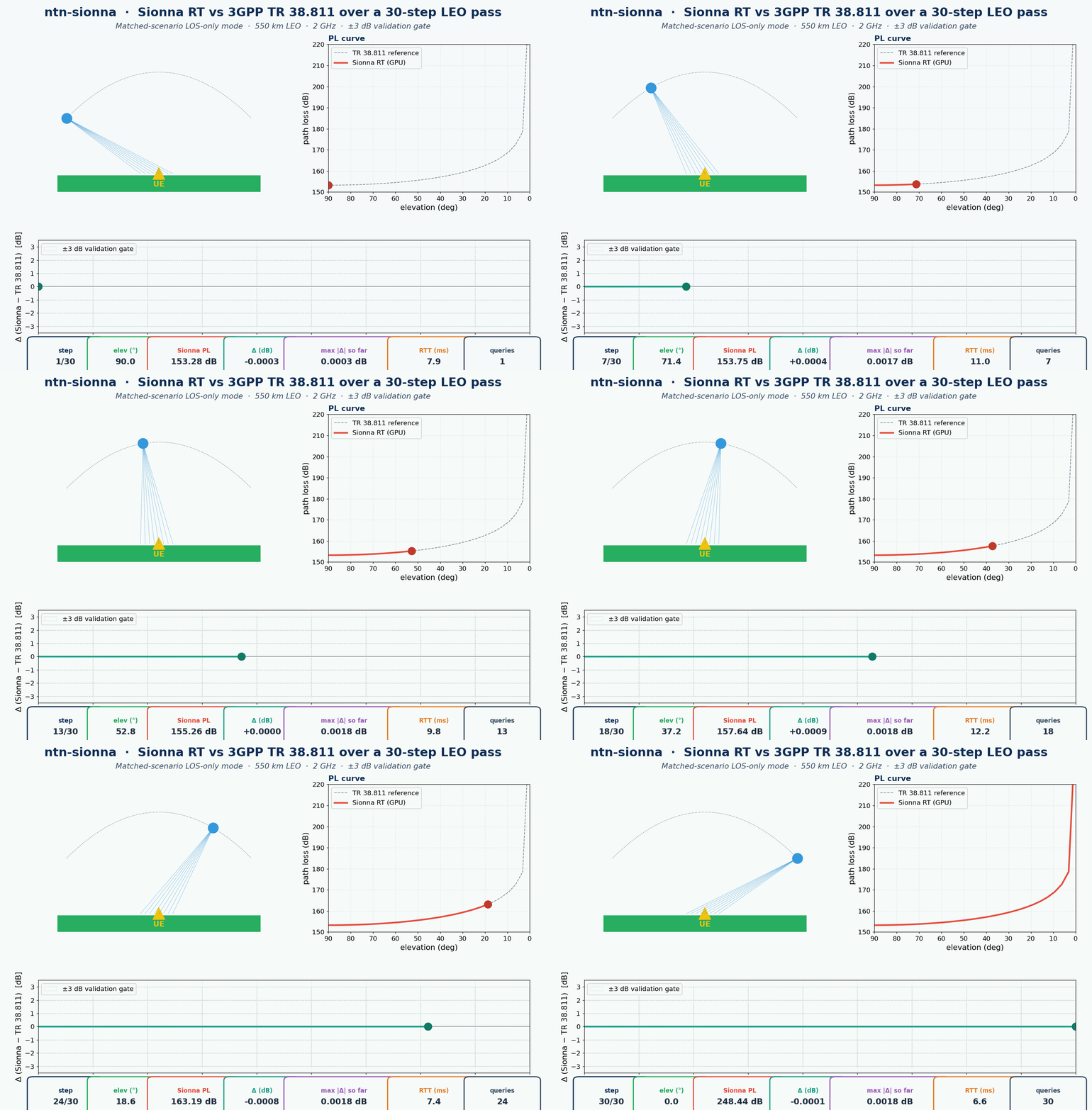
SionnaCalibratorresidual harness checking the ray-traced channel against TR 38.811 within a configurable dB gate (measured max |Δ| of 0.002 dB across a 30-step LEO pass). - Measured-radio data plane - example drivers run a real mmwave NR NTN cell (SpectrumPhy + MAC + HARQ + RLC/PDCP + RRC + EPC) with SGP4 Walker satellite mobility, so SINR, TBLER and goodput are measured off the PHY trace, not asserted.
Gallery
Standards & references
- NVIDIA Sionna RT - GPU ray tracing and channel impulse response generation (Mitsuba 3 differentiable rendering backend).
- ITU-R P.676 - attenuation by atmospheric gases.
- ITU-R P.618 / P.838 - rain attenuation prediction and specific attenuation models.
- ITU-R P.681 - land-mobile-satellite (LMS) shadowing.
- 3GPP TR 38.811 - non-terrestrial network channel reference used as the calibration baseline.
Use cases
- Compare GPU ray-traced path loss against the TR 38.811 closed-form reference across a full LEO elevation pass and quantify the residual.
- Study multipath fading and per-tap Doppler on a moving satellite link where a scalar shadowing term hides constructive and destructive interference.
- Evaluate RIS-assisted recovery of a blocked NLOS satellite link, measuring SINR and goodput before and after the surface engages.
- Sweep a convective rain cell over a Ka-band gateway mid-pass and observe live SINR and goodput dips and recovery through the ITU-R cascade.
- Benchmark SISO versus N×N MIMO terminals on a shared NTN cell with array gain as a measured channel plug-in.
Run it
This Ku-band LEO downlink runs the ITU-R cascade (P.676 gaseous, P.618/P.838 rain, optional P.681 LMS) live in the packet path of a real mmwave NR NTN cell and prints per-second elevation, attenuation, SINR, TBLER and goodput. No GPU is required, the channel falls back to closed-form FSPL when no Sionna transport answers.