title: ntn-v2x - V2X over LEO satellites with SUMO mobility in ns-3 description: Simulate NTN-assisted V2X in ns-3: SUMO-driven vehicles choosing direct or satellite-relay links on the measured SINR of a real mmwave NR LEO cell.
ntn-v2x
ntn-v2x is the ns3-ntn-toolkit module that delivers NTN-assisted V2X for rural and remote roads, driving vehicle mobility from SUMO and making a direct-versus-satellite-relay decision per vehicle on the measured SINR of a real mmwave NR LEO cell, with a URLLC platoon-control flagship and a 2-D maritime scenario.
Why it matters. Vehicular networking research has historically lived in OMNeT++ via Veins, which cannot be lifted into ns-3 without a parallel discrete-event kernel. ntn-v2x mirrors what Veins offers in spirit, a SUMO-driven mobility feed plus vehicular channel decisions, but builds it natively in ns-3 and puts the radio on a real NR protocol stack, so V2X researchers can study satellite-assisted connectivity where terrestrial roadside units do not exist.
What it simulates
- SUMO-driven mobility.
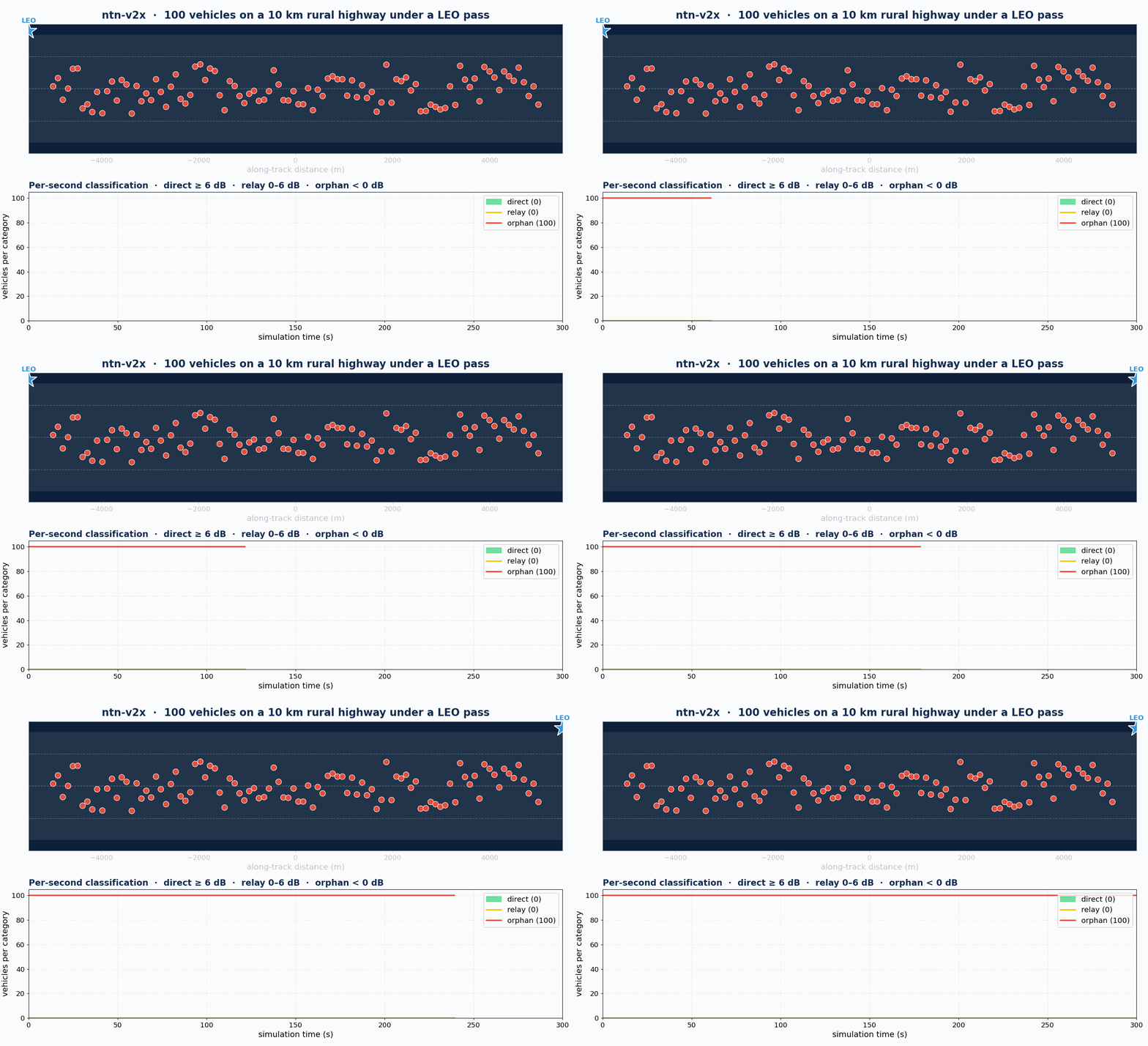
SumoTraciBridgeconnects to a live TraCI v20+ socket or replays an offline FCD CSV trace through a single uniformStep()API, tracking per-vehicle clock jitter. - Direct-versus-relay decision on measured radio. Vehicles are UEs on a real mmwave NR-NTN cell; each one uplinks direct or relays through the best in-range peer based on measured DL SINR, evaluated by
V2xLeoRelay. - Closed-form reference baseline.
V2xLeoDirectcomputes a free-space slant-range link budget (SNR, elevation, above-horizon) for side-by-side comparison against the measured stack. - Measured traffic KPIs. One-way delay, jitter, packet delivery ratio and goodput measured in-band by
NtnOranSinkfromNtnOranPayloadHeader. - URLLC platoon control with edge AI. A hazard-detection xApp consumes KPM features every 100 ms and runs inference at the satellite (
--edge=sat, regenerative payload) or on the ground (--edge=ground), with decision latency as the measured outcome. - Maritime scenario.
MaritimeMobilityModelprovides 2-D vessel mobility (5 to 13 m/s) bounded inside a configurable sea-area box for ship-to-satellite multi-hour runs. - Real multi-hop data plane. Genuine IPv4 forwarding (vehicle to vehicle to LEO to server) with each hop's delay set by real slant-range over c and contact gates driven by live SGP4 geometry.
- CI without SUMO.
NtnV2xHelper::WriteSyntheticFcdCsv()generates reproducible RNG-seeded highway FCD traces for testing without a SUMO install.
Gallery
Standards & references
- 3GPP TR 38.811 - NTN study item; vehicular mobility speed profiles.
- 3GPP TS 28.552 - 5G KPM measurement naming used by the AI flow monitor.
- 3GPP 5QI - QoS classes (5QI 82 URLLC control, 5QI 2 eMBB sensor) for the platoon-control flows.
- SGP4 - LEO orbital propagation for satellite passes.
Use cases
- Rural highway connectivity. Vehicles on roads without roadside units staying connected through direct LEO uplinks.
- V2V-via-LEO relay under NLOS. Blocked vehicles falling back to a relay through an in-range peer with a clear satellite link.
- URLLC platoon control. Comparing satellite-edge versus ground inference placement for time-critical hazard detection.
- Maritime V2X. Ship-to-ship and ship-to-shore messaging over LEO in coastal and open-sea areas.
- Emergency and disaster response. Restoring vehicular connectivity over satellite when terrestrial infrastructure is down.