ntn-slice
ntn-slice is the ns3-ntn-toolkit module that brings 3GPP-compliant network slicing to non-terrestrial networks, running eMBB, URLLC and mMTC slices over LEO and GEO satellites with per-slice PRB orchestration, TS 22.261 demand profiles, and a GEO mode-skip policy that keeps URLLC traffic off the orbital latency floor.
Why it matters. 5G slicing is straightforward when every cell is a few kilometers away, but in NTN a URLLC slice's 5 ms p99 budget is hard-bounded by orbital geometry: a GEO leg adds roughly 120 ms of one-way slant propagation, blowing the budget by more than an order of magnitude regardless of any radio-side allocator. ntn-slice gives 6G NTN researchers a slicing layer that understands the orbital floor, so they can study isolation, PRB allocation and latency-aware routing across mixed LEO and GEO constellations.
What it simulates
- Three co-existing slices on one satellite. eMBB, URLLC and mMTC (plus a V2X SST) with S-NSSAI identifiers, seeded from
DefaultEmbb(),DefaultUrllc()andDefaultMmtc()profiles inntn-slice-types.h. - TS 22.261 demand profiles. Per-slice latency budget, min/max throughput, reliability target, priority and
allowGeoflag drawn from TS 22.261 Table 7.1-1. - Per-slice PRB orchestration.
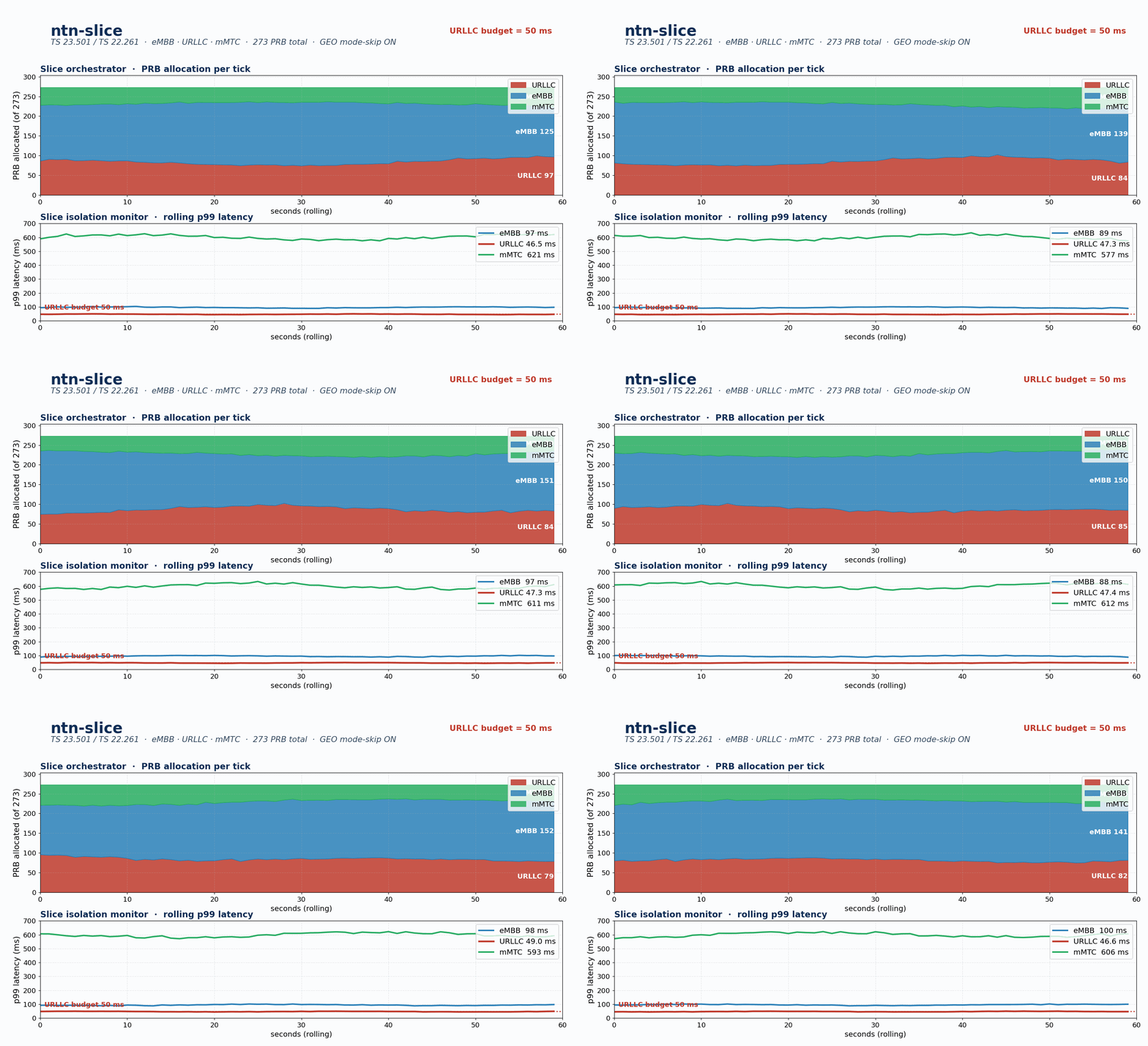
SliceOrchestratorXappreserves min-throughput first (the classical isolation guarantee), then distributes the remainder by priority-weighted unmet demand, or by externally supplied RL shares viaStepWithShares(). - Flow-to-slice selection.
NtnSliceSelectorperforms first-match-wins association by DSCP, destination port range or app label. - GEO mode-skip routing.
ShouldSkipGeo()keeps URLLC traffic on LEO satellites whose round-trip time is compatible with the slice target, recognizing that GEO altitudes (>= 30,000 km) carry a ~240 ms ground-satellite-ground penalty. - Isolation monitoring.
SliceIsolationMonitortracks rolling-window p99 latency and loss rate and emits aBreachEventwhenever a slice violates its SLA. - Real measured radio stack. Examples run real mmwave NR PHY/MAC/RLC/PDCP/RRC/EPC over SGP4 orbital passes with TR 38.811 UE placement and geometric slant-range latency.
Gallery
Standards & references
- 3GPP TS 22.261 - IMT-2020 KPI baseline (Table 7.1-1) for default eMBB/URLLC/mMTC latency, throughput and reliability profiles.
- 3GPP TS 23.501 - 5G system architecture and S-NSSAI (SST + SD) slicing concepts.
- 3GPP TR 38.811 - NTN study item, used for UE placement in the slicing examples.
- 3GPP TR 38.913 - NR channel models and IMT-2020 requirements.
Use cases
- URLLC over LEO. Verifying that mission-critical control traffic stays on low-latency LEO links while bulk traffic uses GEO.
- Slice isolation guarantees. Stress-testing whether a saturated eMBB slice can starve URLLC or mMTC on a shared satellite.
- RL-driven orchestration. Feeding learned PRB shares from the
ns3-aiSliceEnvintoStepWithShares()and measuring satisfaction. - Mixed LEO/GEO planning. Studying how slice admission and routing change as a constellation blends LEO and GEO assets.
- SLA breach detection. Characterizing p99 latency and loss thresholds that trigger isolation breach events.