Architecture
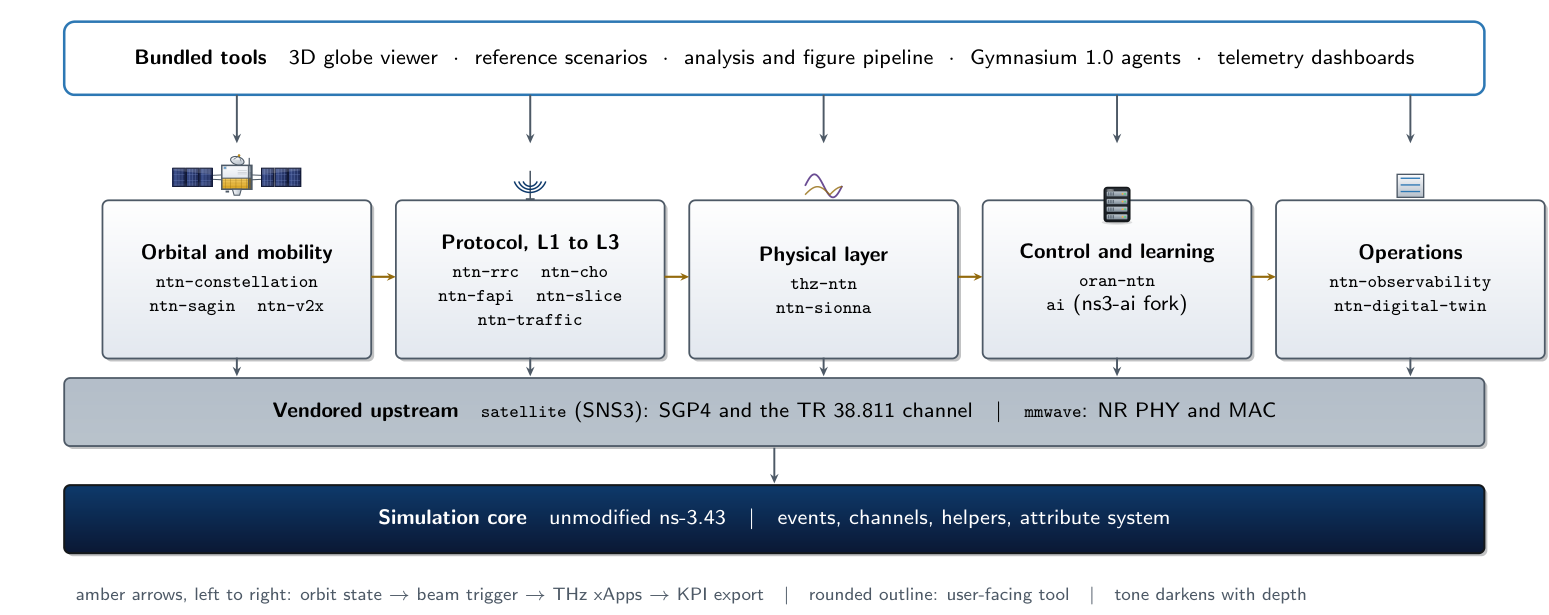
The organising idea
Five layers sit on two vendored upstream stacks, which sit on an unmodified ns-3.43 core. Nothing in the core is patched, which is what makes the toolkit trackable against upstream ns-3 releases rather than a permanent fork.
The layering is not decorative. Each layer only knows about the one below it, so
a scenario can replace a layer without the ones above noticing. The orbital layer
does not know a radio exists. The radio does not know a RIC exists. The RIC gets
its measurements through E2SM-KPM rather than by reaching into the PHY. This is
what lets oran-ntn run over either radio backend, and what lets ntn-sionna
substitute a ray-traced channel for a closed-form one without touching a
scenario.
The single most important property
The decision plane and the measurement plane are the same plane.
That sentence is doing real work. In a simulation, it is easy and common for a control decision to be evaluated against numbers that the decision could not have affected: a handover trigger that fires while a counter increments beside an unrelated SINR series. The result looks like a closed loop and is not one, and no amount of running it longer will reveal the gap.
Here, a trigger that fires calls into the RRC, which moves the terminal onto a
different cell, whose SINR is then measured off the spectrum PHY by the same
accumulator that fed the trigger. When that property fails somewhere, the toolkit
says so in sim_health.csv rather than leaving it to be inferred.
The five layers
Orbital and mobility
ntn-constellation propagates the shell, from two-line elements or from orbital
elements, and owns the contact graph over inter-satellite links including limb
clearance. ntn-sagin adds the air and ground layers, UAV and HAPS, with a
TR 36.777 channel. ntn-v2x puts vehicles under the shell with NR sidelink.
Everything above consumes one ephemeris, which is the reason coordinate frames agree: there is only one source of position.
Protocol, L1 to L3
ntn-traffic is the spine. NtnRealStackHelper assembles a genuine NR cell,
mmWave FR2 or 5G-LENA nr at FR1, under that ephemeris: SpectrumPhy, LDPC error
model, HARQ, RLC, PDCP, RRC, EPC and GTP, with TR 38.811 NTN physics chained onto
the channel and timers relaxed to the slant round trip.
ntn-cho decides when to hand over, ntn-rrc carries the SIB19 timing that makes
uplink work over a round trip the terrestrial standard never anticipated,
ntn-fapi exposes the MAC-PHY boundary, and ntn-slice differentiates the
traffic across it.
Physical layer
thz-ntn and ntn-sionna both replace or augment the propagation chain rather
than sitting beside it: a THz atmospheric term or a ray-traced channel impulse
response attenuates real packets and shows up in the measured SINR.
Control and learning
oran-ntn closes the loop. E2SM-KPM indications carry measurements up, E2SM-RC
control actions and A1 policies come back down, and the E2 latency between them
is taken from live slant geometry, which is what makes the RIC placement question
answerable. ns3-ai-ntn exposes the same loop to a Gymnasium agent.
Operations
ntn-observability records the scene once and exports it four ways.
ntn-digital-twin runs the prediction outside the simulation and pushes the
decision back in.
One run, end to end
flowchart TD
    A["CelesTrak / Space-Track<br/>two-line elements"] --> B["ntn-constellation<br/>SGP4, ISL contact graph, presets"]
    B --> C["contrib/satellite (SNS3)<br/>SatSGP4MobilityModel"]
    C --> D["ntn-traffic · NtnRealStackHelper<br/>NR SpectrumPhy, HARQ, RLC, PDCP, RRC, EPC"]
    D --> P["thz-ntn / ntn-sionna<br/>atmospheric and ray-traced channel"]
    P --> D
    D --> E["ntn-rrc<br/>SIB19, K_offset, timing advance, DRX"]
    E --> F["ntn-cho<br/>time-to-exit conditional handover"]
    F -->|"RRC reconfiguration with sync"| D
    D --> G["oran-ntn<br/>E2SM-KPM indications"]
    G --> H["Near-RT RIC and xApps<br/>on-board · gateway · cloud"]
    H -->|"E2SM-RC action, A1 policy"| D
    H --> I["ns3-ai-ntn<br/>Gymnasium environments"]
    I --> H
    D --> J["ntn-slice<br/>per-5QI bearers, SLA percentiles"]
    D --> K["ntn-observability<br/>sim_health.csv, KPM series, CZML, InfluxDB"]
    K --> L["ntn-digital-twin<br/>FastAPI prediction"]
    L -->|"actuated handover"| F
The two loops that matter are the ones drawn back into ntn-traffic: the
handover path and the RIC path. Both terminate at the radio, which is why their
effect is measurable.
Layer by layer
| Layer | Modules | Responsibility |
|---|---|---|
| Orbital and mobility | ntn-constellation, ntn-sagin, ntn-v2x |
One ephemeris for the whole run; contact graph; air, ground and vehicular layers |
| Protocol, L1 to L3 | ntn-traffic, ntn-cho, ntn-rrc, ntn-fapi, ntn-slice |
The measured NR data plane and the control that shapes it |
| Physical layer | thz-ntn, ntn-sionna |
Channel models chained onto the real propagation path |
| Control and learning | oran-ntn, ns3-ai-ntn |
E2 and A1 loops, RIC placement, RL environments |
| Operations | ntn-observability, ntn-digital-twin |
Export, visualization, and closed-loop prediction |
| Vendored upstream | satellite (SNS3), mmwave, nr (5G-LENA), netsimulyzer |
SGP4 mobility and antenna corpus; the NR PHY and MAC; 3D playback |
| Simulation core | ns-3.43, unmodified | Events, channels, helpers, the attribute system |
Where the boundaries are
An architecture page that only lists what is present is half a document. The toolkit's boundaries are stated in SCOPE_AND_LIMITATIONS.md, and the ones most likely to affect an experiment design are:
- The air interface carries no propagation delay in the shipped runs; the NTN slant delay rides the transport leg, and the health record says so per row.
- The multi-tap TR 38.811 NTN-TDL is not implemented; the measured channel carries large-scale loss with the spectrum model's own fading.
- The in-simulation E2 transport is an ns-3 header, not ASN.1 APER over SCTP; the wire-level path is the FlexRIC bridge.
- Release 19 AI/ML lifecycle management is absent entirely.
Next
- Getting started to build and run
- Modules for what each one does
- Papers for the work built on it