satellite - SNS3 (Satellite Network Simulator 3)
satellite is the vendored SNS3 (CNES/Magister) module that ns3-ntn-toolkit builds on for full multi-beam satellite networking in ns-3, providing SatSGP4 orbital mobility, the SatChannel signal-power model, and a complete DVB-S2 forward and DVB-RCS2 return-link protocol stack. Originally developed by Magister Solutions under European Space Agency contract, it is the historical anchor of satellite simulation in ns-3 and is reused unmodified as the toolkit's link-layer and channel base.
Why it matters. Standards-grade non-terrestrial research needs more than a path-loss formula, it needs a real DVB-S2/RCS2 MAC, capacity request signaling, link-budget BLER, and validated orbital propagation. SNS3 supplies all of that as a battle-tested ESA-funded base, so ns3-ntn-toolkit can layer LEO constellations, conditional handover and ray-traced channels on top of a credible satellite stack rather than reinventing it.
What it simulates
- SatSGP4 orbital mobility -
SatSGP4MobilityModelruns the full SGP4/SDP4 propagator (TLE input) and exposes WGS84/GRS84 geodetic and spherical coordinate systems alongside Cartesian, so satellite, gateway and user-terminal nodes share a consistent earth frame. - SatChannel signal-power model - a dedicated
SatChannelimplements satellite received-signal-power calculation with per-beam channel pairs, channel estimation error containers, and Markov/Loo fading traces. - DVB-S2 / DVB-S2X forward link - Time Division Multiplexing BB-frame structure with adaptive coding and modulation across the 16 forward carriers.
- DVB-RCS2 return link - MF-TDMA with superframe, frame and time-slot scheduling, Return Link Encapsulation, ARQ, and dynamic capacity (RBDC/VBDC) requested from the Network Control Center.
- Link-results BLER tables -
SatLinkResultsloads measured BLER-versus-Es/No tables per waveform so PHY decoding reflects real DVB-S2/RCS2 modcod performance rather than an idealized threshold. - Multi-beam GEO reference system - a 72 spot-beam, 5-gateway geostationary Ka-band reference network with four-color frequency reuse, plus beam hopping, ESSA, LoRaWAN, inter-satellite link (ISL) routing, and gateway and user-terminal handover.
Gallery
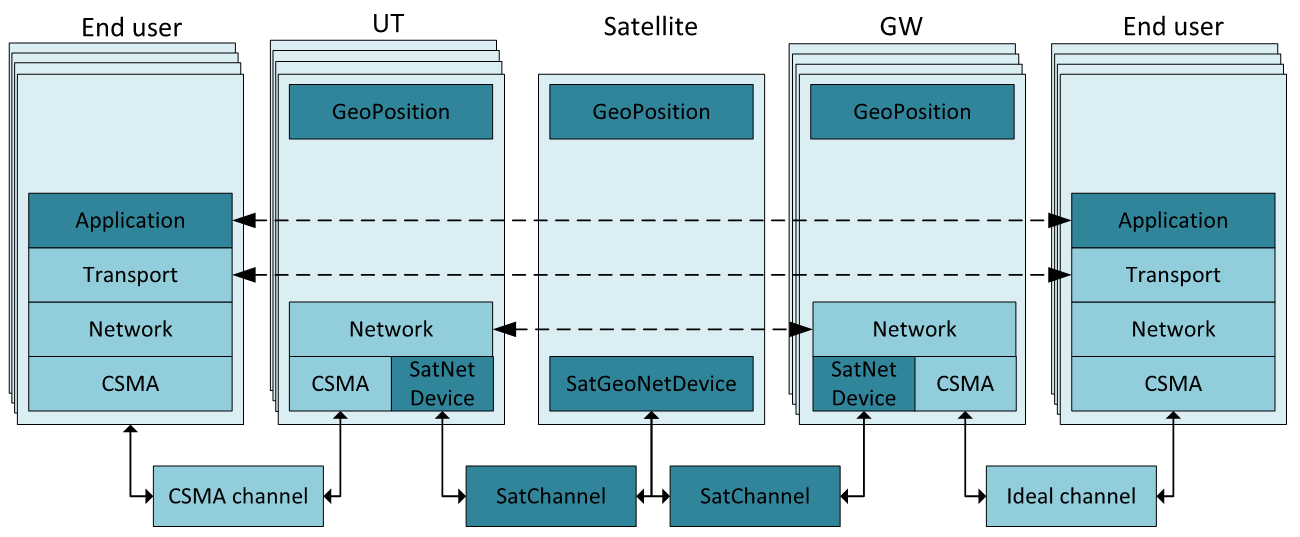
Standards & references
- ETSI DVB-S2 - forward-link Time Division Multiplexing with adaptive coding and modulation.
- ETSI DVB-S2X - extended modcods and finer granularity on the forward link.
- ETSI DVB-RCS2 - return-channel MF-TDMA, superframe structure and capacity-request signaling.
- 3GPP TR 38.811 - non-terrestrial network reference for positioning SNS3 alongside the toolkit's 5G NR NTN channel.
- AIAA SGP4/SDP4 - orbital propagation from two-line element sets used by
SatSGP4MobilityModel.
Use cases
- Model a 72-beam GEO Ka-band broadband system with DVB-S2 forward and DVB-RCS2 return links and study end-to-end goodput under realistic BLER.
- Drive
SatSGP4MobilityModelfrom TLE or constellation ephemeris to simulate LEO satellite passes and beam dynamics. - Evaluate DVB-RCS2 dynamic capacity allocation (RBDC/VBDC) under HTTP, CBR or on-off traffic against the NCC scheduler.
- Study gateway and user-terminal handover and inter-satellite link routing across a multi-satellite topology.
- Validate link-budget and SINR behavior against the SNS3 link-results tables before layering ray-traced or 5G NR NTN channels on top.
Run it
This example builds a satellite constellation with SatSGP4 mobility and the SatChannel signal-power model, exercising the DVB-S2/RCS2 stack end to end. Other ready-to-run drivers include sat-cbr-example, sat-link-budget-example, sat-handover-example and sat-fwd-link-beam-hopping-example.