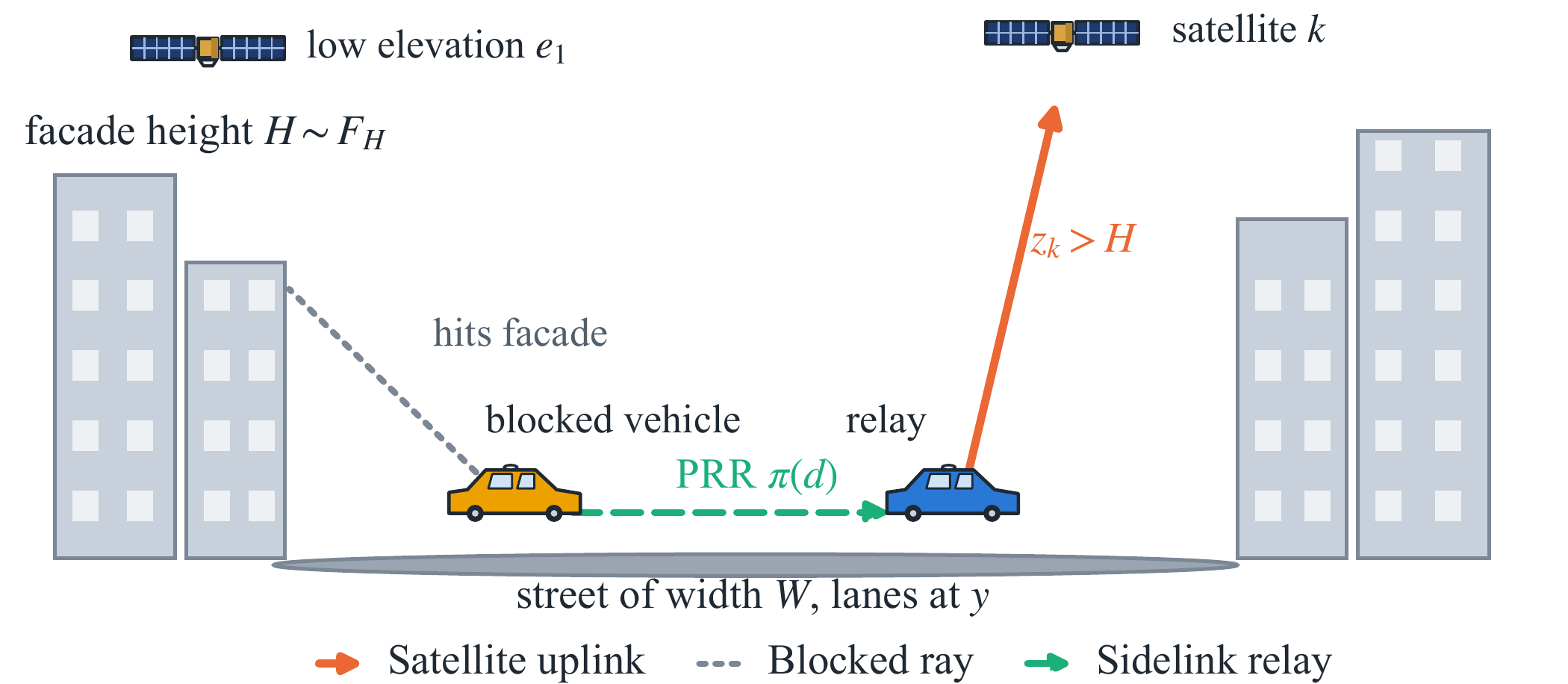
What ntn-v2x does
ntn-v2x is an ns-3 module for satellite-assisted vehicle-to-everything communication that combines an NR PC5 sidelink Mode 2 model, SAE J2735 basic safety messages encoded as ns-3 headers, and direct-or-relay decisions that start and stop real uplink flows to LEO satellites. Vehicle motion comes from replayed floating-car data, and the satellite leg uses SGP4 orbits over an NR NTN cell or a point-to-point path.
Accompanying studyWhich Neighbor Should Forward? Sidelink Relaying of Vehicle Status to Direct-to-Cell Satellites in Urban Street Canyons. Code and data are in this repository.
What it models
The sidelink follows NR PC5 Mode 2 as described in 3GPP TS 38.321 Section 5.22, with an SL-ResourcePool of subchannels and slots (TS 38.331). NtnSlUeMac performs sensing-based autonomous selection: candidates in the T1 to T2 window, exclusion above an SL-RSRP threshold, the 20 percent rule with 3 dB steps, and periodic reservation with a reselection counter. NtnSlChannel applies the TR 37.885 highway LOS path loss with log-normal shadowing and NLOSv blockage, enforces half duplex, decodes on SINR with co-channel interference summed in linear power, and reports PRR by distance following TS 38.885. It is a MAC abstraction and does not decode PSCCH or PSSCH bits or combine HARQ.
Basic safety messages are SAE J2735 (2016) BSMcoreData, 21 octets on the wire with UPER offset-from-lower-bound integers and the standard's range clamps. SumoTraciBridge replays floating-car data offline and applies both position and velocity, so BSM speed and heading fields are real; live TraCI co-simulation is not implemented. V2xLeoRelay assigns each vehicle direct or relay service from a minimum direct SNR and a maximum V2V range, and a runtime transmit gate lets those decisions start and stop flows mid-run. The satellite leg uses SGP4 orbits over an NR NTN cell or a point-to-point path whose delay follows slant range, with TR 38.811 and TR 38.821 for its geometry and budget. V2xLeoDirect, a closed-form TR 38.821 Set-1 S-band budget, is kept as a reference. TS 23.287 is cited for the V2X architecture.
Measured numbers
Age of information at the server when a blocked vehicle forwards through the nearest neighbor that announced an uplink, urban and dense canyon
ntn-v2x-canyon-relay study: 638 Starlink direct-to-cell satellites via SGP4 (element sets of 2 October 2026), straight Manhattan street with per-run facade heights, LOS by ray geometry every 100 ms, SUMO stop-and-go traffic on a 1.2 km ring, one report per vehicle per second, assumed 300 kb/s shared uplink per satellite; median over 20 startsAge of information using the serving satellite only, urban and dense canyon
Same canyon study; median over 20 startsAge of information using any satellite in line of sight, urban and dense canyon
Same canyon study; median over 20 startsMedian model error on the age above its floor over eight baseline forwarding rules, urban and dense canyon
Same canyon study, analytical model against ns-3Measured sidelink PRR within 50 m at 10 vehicles, and at 30 and 60 vehicles
Shipped highway scenario at 23 dBm and 5.9 GHz with the TR 37.885 highway model; residual loss from half duplex and same-subchannel collisionsTraffic from terminals allowed on air against traffic from gated terminals under the relay transmit gate
Default run, re-measured on 2026-09-01 at 2.185 GHz and 20 MHzEach number states the run it comes from; the README of the module lists the command that reproduces it.
Standards it follows
| 3GPP TS 38.321 | Section 5.22 sidelink Mode 2 resource selection |
| 3GPP TS 38.331 | SL-ResourcePool configuration |
| 3GPP TS 38.885 | V2X evaluation methodology and PRR (designation as written in the module docs) |
| 3GPP TR 37.885 | Highway and urban sidelink channels, PRR evaluation |
| 3GPP TS 23.287 | V2X architecture |
| SAE J2735 | Basic safety message core data and UPER encoding |
| 3GPP TR 38.811 | Satellite leg |
| 3GPP TR 38.821 | Satellite leg; Set-1 S-band defaults of V2xLeoDirect |
New on 6g-ntn.live
The toolkit now runs in the browser at 6g-ntn.live: pick an example of ntn-v2x or any other module, change its parameters, and the real ns-3 binary runs on the server.
Type ./ns3 run with your own arguments; the real binary runs on the server and streams its output.
Open →115 runnable examplesEvery example of the 14 modules, each with a typed parameter form and its measured KPIs.
Open →Live 3D globeReal constellations from CelesTrak elements, propagated with SGP4, with their service and feeder links.
Open →Open datasetsEvery finished run becomes a dataset under CC BY 4.0, with its provenance and configuration.
Open →Validation690 test cases in 41 toolkit suites, and a health check on every example.
Open →Shared scenariosResearchers post a configuration with its parameters and results; anyone can rerun it.
Open →Watch
Watch on YouTube: the NTN Control Center running and visualizing the toolkit examples, in five minutes.
Install
Every module ships in the ready-built container image of the toolkit (version 3.0.1):
docker pull uzairdocker69/ns3-ntn-toolkit:latest
docker run --rm -it uzairdocker69/ns3-ntn-toolkit:latest bash
To build from source, clone ns3-ntn-toolkit, which vendors this module under contrib/, or follow the README of this repository (branch ntn-v2x-v4).
Cite
If you use ntn-v2x, please cite the toolkit article (doi:10.1109/OJCOMS.2026.3745010):
@article{uzair2026ns3ntntoolkit,
  author  = {Uzair, Muhammad and Aldahlan, Bassma G. and Albar, Ali A. and
             Althumali, Huda and Alghammas, Adnan},
  title   = {ns3-ntn-toolkit: An Integrated ns-3 Platform for 6G
             Non-Terrestrial Networks},
  journal = {IEEE Open Journal of the Communications Society},
  volume  = {7},
  pages   = {13440--13467},
  year    = {2026},
  doi     = {10.1109/OJCOMS.2026.3745010}
}