What ntn-slice does
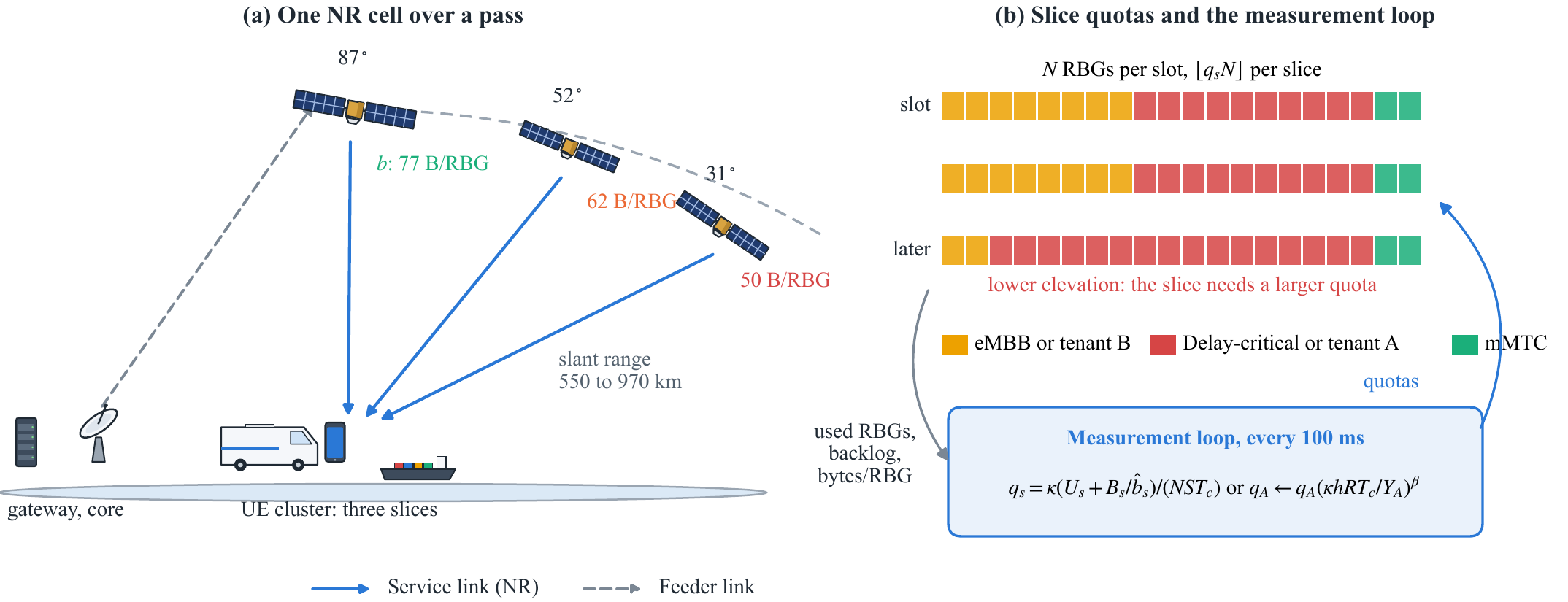
ntn-slice is an ns-3 module for network slicing on a non-terrestrial (LEO satellite) cell, in which a 5G-LENA proportional-fair scheduler enforces a per-slot resource block group quota for each slice and lends unused groups to other slices. It also provides S-NSSAI and slice-profile classes, quota controllers that follow the satellite pass, and an isolation monitor that reports per-slice delay percentiles.
Accompanying studyQuota, Priority or Rate Cap? Matching the Slicing Mechanism to the Promise on a Receding Low Earth Orbit Satellite. Code and data are in this repository.
What it models
The core of the module is NtnSliceQuotaScheduler, derived from the 5G-LENA OFDMA proportional-fair scheduler. A slice with demand receives at least floor(quota x RBGs) resource block groups per slot, and leftover groups go to any slice with data, so the partition is enforced in the MAC rather than labeled on packets. Quotas are set by controllers in the examples: from the satellite ephemeris, from measured backlog and bytes per RBG, or from a tenant rate contract with a delivered-rate trim (TrimmedQuota). The quota scheduler acts on the downlink only; the uplink stays plain proportional fair.
Around the scheduler sit the slice vocabulary of 3GPP TS 23.501 (S-NSSAI as 8-bit SST plus 24-bit SD, 5QI), default eMBB, URLLC and mMTC profiles after TS 22.261 Table 7.1-1, and a flow selector that matches DSCP, port ranges and application labels. A helper applies a GEO mode-skip rule for latency-bound slices, treating satellites above 30 000 km as GEO. SliceIsolationMonitor keeps a delay histogram, so a reported p99 is a percentile and not a mean, and records breach events. SliceOrchestratorXapp computes a PRB split for an RL policy, but it is a shadow allocator whose decisions are logged and do not reach the MAC. The examples run over SGP4 satellite geometry with TR 38.811 excess loss on a 5G-LENA cell, and the module cites TS 38.300, TS 38.101-5 and TR 38.821 for QoS flow mapping, NTN FR1 bandwidths and latency budgets.
Measured numbers
Delay-critical slice p99 one-way delay with the measured closed-loop quota (reactive)
One 2.185 GHz, 20 MHz cell (numerology 1) via a 550 km, 53 degree SGP4 satellite, elevation 87 to 31 degrees over 120 s; 16 Mb/s delay-critical slice with 50 ms budget at full load; median over 12 seedsDelay-critical slice p99 delay with the ephemeris-driven quota (predict)
Same pass-study setup; median over 12 seedsDelay-critical slice p99 delay with a static quota sized at the start of the pass; 52 % of windows over target
Same pass-study setup; median over 12 seedsDelay-critical slice p99 delay with plain PF and no slices; 91 % of windows over target
Same pass-study setup; median over 12 seedsBytes carried per RBG by the delay-critical slice at 87 and at 31 degrees elevation (36 % less), raising the needed quota from 0.48 to 0.74 of the RBGs
Calibration seed of the pass studyTenant A throughput under the trimmed contract loop (contract_trim), with tenant B at 19.8 Mb/s
Two tenants on one cell, contract R = 12 Mb/s for tenant A, decoding errors on, tenant B pausing mid-run; medians over 12 seedsEach number states the run it comes from; the README of the module lists the command that reproduces it.
Standards it follows
| 3GPP TS 23.501 | S-NSSAI, 5QI and standardized QoS characteristics |
| 3GPP TS 22.261 | Service requirements; default eMBB, URLLC and mMTC slice profiles (Table 7.1-1) |
| 3GPP TS 38.300 | QoS flow to DRB mapping |
| 3GPP TS 38.101-5 | NTN FR1 channel bandwidths |
| 3GPP TR 38.811 | NTN channel; excess loss on the slicing study cell |
| 3GPP TR 38.821 | NTN latency budgets; modeled transparent-GEO service and feeder legs |
New on 6g-ntn.live
The toolkit now runs in the browser at 6g-ntn.live: pick an example of ntn-slice or any other module, change its parameters, and the real ns-3 binary runs on the server.
Type ./ns3 run with your own arguments; the real binary runs on the server and streams its output.
Open →115 runnable examplesEvery example of the 14 modules, each with a typed parameter form and its measured KPIs.
Open →Live 3D globeReal constellations from CelesTrak elements, propagated with SGP4, with their service and feeder links.
Open →Open datasetsEvery finished run becomes a dataset under CC BY 4.0, with its provenance and configuration.
Open →Validation690 test cases in 41 toolkit suites, and a health check on every example.
Open →Shared scenariosResearchers post a configuration with its parameters and results; anyone can rerun it.
Open →Watch
Watch on YouTube: the NTN Control Center running and visualizing the toolkit examples, in five minutes.
Install
Every module ships in the ready-built container image of the toolkit (version 3.0.1):
docker pull uzairdocker69/ns3-ntn-toolkit:latest
docker run --rm -it uzairdocker69/ns3-ntn-toolkit:latest bash
To build from source, clone ns3-ntn-toolkit, which vendors this module under contrib/, or follow the README of this repository (branch ntn-slice-v4).
Cite
If you use ntn-slice, please cite the toolkit article (doi:10.1109/OJCOMS.2026.3745010):
@article{uzair2026ns3ntntoolkit,
  author  = {Uzair, Muhammad and Aldahlan, Bassma G. and Albar, Ali A. and
             Althumali, Huda and Alghammas, Adnan},
  title   = {ns3-ntn-toolkit: An Integrated ns-3 Platform for 6G
             Non-Terrestrial Networks},
  journal = {IEEE Open Journal of the Communications Society},
  volume  = {7},
  pages   = {13440--13467},
  year    = {2026},
  doi     = {10.1109/OJCOMS.2026.3745010}
}