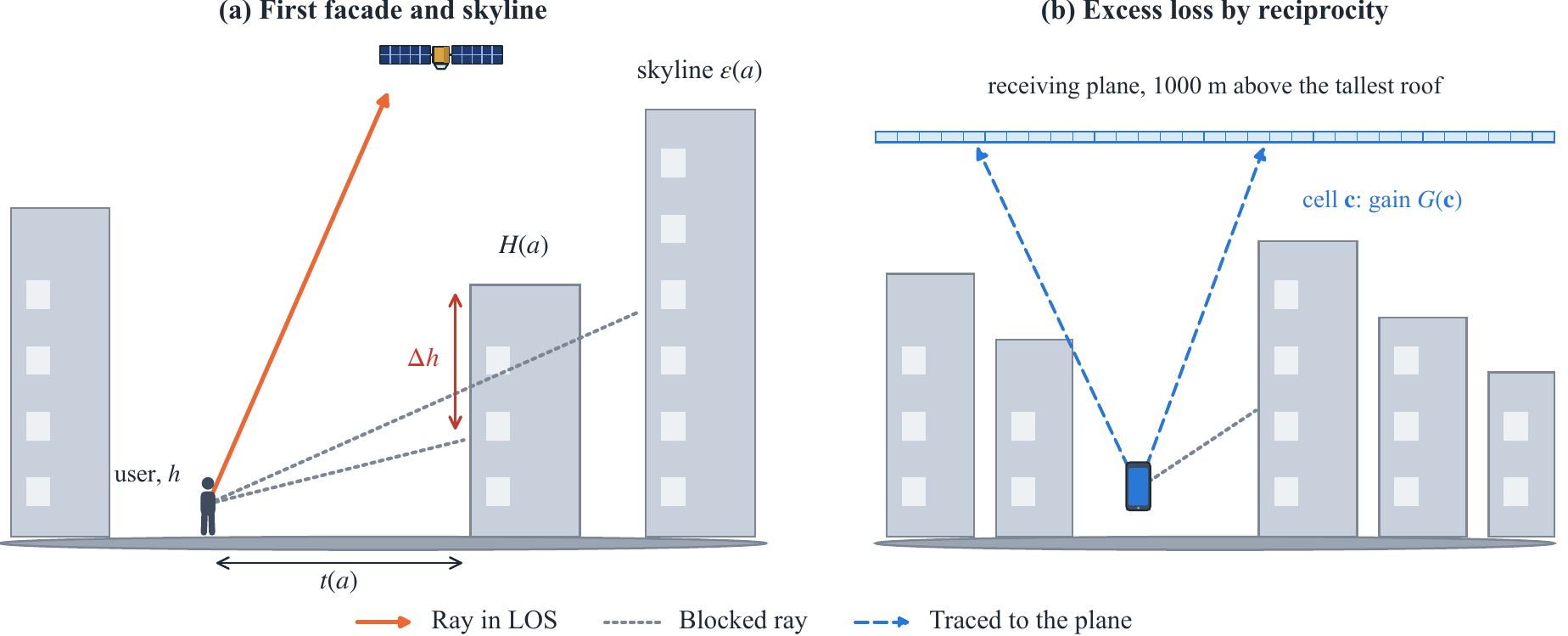
What ntn-sionna does
ntn-sionna is an ns-3 module that bridges NVIDIA Sionna RT ray tracing into ns-3 through an opt-in PropagationLossModel, which sends transmitter, receiver and frequency queries to a Sionna RT server holding the scene on a GPU. Traced and fallback evaluations are counted separately, and caching and replay transports let a simulation run without a GPU.
Accompanying studyWhat Street Geometry Adds to Elevation Tables: Ray-Traced Line of Sight and Excess Loss for Direct-to-Cell Satellites in Cities. Code and data are in this repository.
What it models
NtnSionnaChannel is an opt-in PropagationLossModel that streams {tx, rx, freq_hz} queries to sionna-server.py, which keeps a scene resident on a GPU and answers with a scalar path loss and a path count over UDP (default port 8765); the GPU need not be on the machine running ns-3. Transports are pluggable: UDP, an in-process pybind build, a 4-D LRU caching decorator whose key includes array, RIS and LOS-only settings, and a record-and-replay transport that runs without a GPU. If the server times out, the model falls back to free-space loss, counts the fallback separately, and with SetRequireLiveTransport(true) makes a missing server fatal. The closed-form 3GPP TR 38.811 channel stays the default.
Because Sionna RT does not model the atmosphere, NtnSionnaCascadeChannel adds an ITU-R chain on top of the traced loss: P.676 gaseous absorption, P.618 and P.838 rain, and P.681 land mobile satellite shadowing. The same chain is available as an excess-only loss model that can be added to any spectrum channel without counting FSPL twice. SionnaCirPropagationLossModel applies multipath taps with per-tap Doppler from the endpoints' live velocity, but the taps are supplied by the caller and are not ray traced. SionnaCalibrator reports the residual of traced loss against the TR 38.811 reference with a declared LOS mode and gate. Python tools convert OpenStreetMap and LiDAR data into scenes. Measured-radio examples run the loss on an NR or mmwave NTN cell from ntn-traffic with SGP4 Walker mobility, and TR 38.901 is cited alongside TR 38.811.
Measured numbers
Ray-traced LOS probability at 30 degrees elevation for street-level users in Florence, Munich, San Francisco and Paris
Sionna RT 2.0.1 run directly from Python, not through the ns-3 bridge; Sionna RT city scenes, 300 outdoor users per city at 1.5 m, two user realizations, 2 GHz, isotropic antennas, LOS plus reflection and edge diffraction to depth 3 with 10^9 rays per user; ray traced, not field measurementsMean error of the better TR 38.811 LOS table per city against the traced LOS curve (largest error 7 to 21 points)
Same Sionna RT study, four city scenesAmount by which the censored median excess loss of blocked directions lay below the TR 38.811 clutter loss in every city below 60 degrees elevation
Same Sionna RT study with smooth 0.3 m concrete facades over both user realizations, intervals about plus or minus 3 dBEach number states the run it comes from; the README of the module lists the command that reproduces it.
Standards it follows
| 3GPP TR 38.811 | NTN reference channel; the default model and the calibration baseline |
| 3GPP TR 38.901 | Cited reference channel; model-B screen used for facade blockage in the RIS relay example |
| ITU-R P.676 | Gaseous absorption in the atmospheric cascade |
| ITU-R P.618 | Rain attenuation in the cascade |
| ITU-R P.838 | Rain specific attenuation |
| ITU-R P.681 | Land mobile satellite shadowing |
New on 6g-ntn.live
The toolkit now runs in the browser at 6g-ntn.live: pick an example of ntn-sionna or any other module, change its parameters, and the real ns-3 binary runs on the server.
Type ./ns3 run with your own arguments; the real binary runs on the server and streams its output.
Open →115 runnable examplesEvery example of the 14 modules, each with a typed parameter form and its measured KPIs.
Open →Live 3D globeReal constellations from CelesTrak elements, propagated with SGP4, with their service and feeder links.
Open →Open datasetsEvery finished run becomes a dataset under CC BY 4.0, with its provenance and configuration.
Open →Validation690 test cases in 41 toolkit suites, and a health check on every example.
Open →Shared scenariosResearchers post a configuration with its parameters and results; anyone can rerun it.
Open →Watch
Watch on YouTube: the NTN Control Center running and visualizing the toolkit examples, in five minutes.
Install
Every module ships in the ready-built container image of the toolkit (version 3.0.1):
docker pull uzairdocker69/ns3-ntn-toolkit:latest
docker run --rm -it uzairdocker69/ns3-ntn-toolkit:latest bash
To build from source, clone ns3-ntn-toolkit, which vendors this module under contrib/, or follow the README of this repository (branch ntn-sionna-v4).
Cite
If you use ntn-sionna, please cite the toolkit article (doi:10.1109/OJCOMS.2026.3745010):
@article{uzair2026ns3ntntoolkit,
  author  = {Uzair, Muhammad and Aldahlan, Bassma G. and Albar, Ali A. and
             Althumali, Huda and Alghammas, Adnan},
  title   = {ns3-ntn-toolkit: An Integrated ns-3 Platform for 6G
             Non-Terrestrial Networks},
  journal = {IEEE Open Journal of the Communications Society},
  volume  = {7},
  pages   = {13440--13467},
  year    = {2026},
  doi     = {10.1109/OJCOMS.2026.3745010}
}