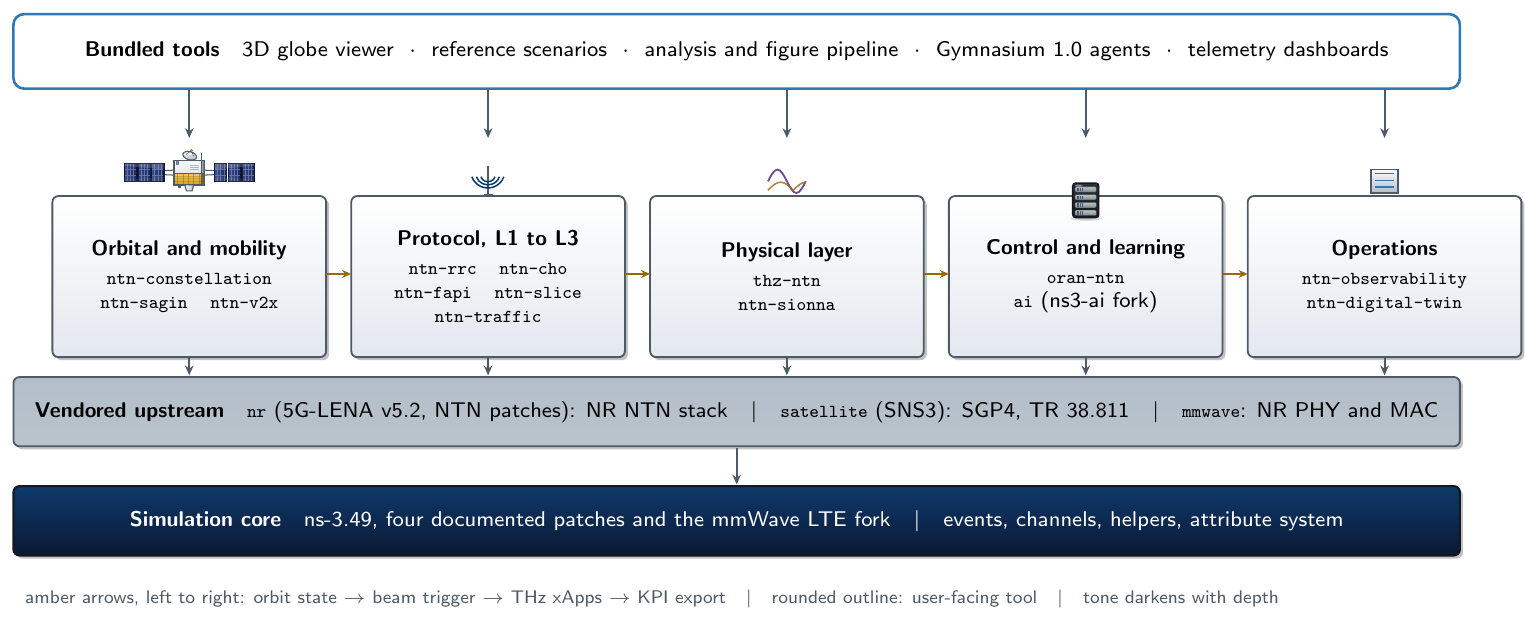
What ntn-observability does
ntn-observability is an ns-3 module that records satellite positions, measured radio KPIs and control events from a non-terrestrial network simulation and exports them as InfluxDB line protocol, NetSimulyzer scene JSON and CZML. A reproducibility manifest and a single metric schema keep every exported measurement traceable to the run and the code that produced it.
What it models
The module is a telemetry and visualization layer, not a radio model. It takes what the simulation already measures (PHY SINR, TBLER, sink goodput, SGP4 positions, elevation and slant range, and control events such as handover, timing advance, SIB19 and DRX) and writes it out in the formats operators use. NtnInfluxSink emits InfluxDB v2 line protocol with key escaping, file or UDP transport, run-id tags and a bounded buffer that drops and counts the oldest points. NtnSceneRecorder is a single tap that reads mobility positions in ECEF or local ENU (converted to ECEF), KPIs and events, and fans them out to the NIST NetSimulyzer 1.0 JSON schema and to CZML for a Cesium globe. Serving and handover links travel alongside positions, so a viewer shows which satellite serves which terminal at a time that maps back to simulation time.
A header-only schema names every measurement, tag and field once, using 3GPP TS 28.552 and TS 32.425 measurement names and O-RAN E2SM-KPM identities. NtnReproManifest records git SHA, ns-3 version, scenario, seed, TLE epoch and command-line arguments, and can be written and read back. Per-flow KPM series come from NtnOranAiFlowMonitor in ntn-traffic. A Docker stack with InfluxDB 2.7, Grafana 10.4 and Telegraf ships four dashboards (Overview, Handover, Radio, ISL), and a script traces each Grafana panel back to the code that emits it. The band tag follows the carrier as an IEEE Std 521 letter band.
Measured numbers
mean per-second SINR read back from the exported line-protocol file
one run of ntn-observability-traffic, 60 s, 550 km SGP4 pass (elevation 89.2 to 51.3 deg), 20 GHz, 85 dBm EIRP, seed 1; June 2026 sweep on earlier codemean per-second goodput read back from the exported line-protocol file
same ntn-observability-traffic run (60 s, 550 km, 20 GHz, 85 dBm EIRP, seed 1)whole-run one-way delay from in-band timestamps
same run, from its sim_health.csv with all rows passing; whole-run SINR 24.96 dB, TBLER 0.033, 4.71 Mb/s, 26,119 transport blocks receivedwhole-run application loss
same ntn-observability-traffic run, from sim_health.csvmean downlink SINR of ntn-netsimulyzer-official-demo (TBLER 0.041, 16.58 Mb/s; scene with 190 events)
6 SGP4 satellites, 4 TR 38.811 UEs, 15 s, same June 2026 sweepEach number states the run it comes from; the README of the module lists the command that reproduces it.
Standards it follows
| 3GPP TS 28.552 | performance measurement names in the metric schema |
| 3GPP TS 32.425 | performance measurement names in the metric schema |
| O-RAN E2SM-KPM | measurement identities for KPM series |
| IEEE Std 521 | letter-band label written in the band tag |
| CZML | time-dynamic scene for a Cesium globe in the ECEF (FIXED) frame |
| InfluxDB line protocol | time-series export through NtnInfluxSink |
| NetSimulyzer scene JSON 1.0 | streaming 3D scene export |
New on 6g-ntn.live
The toolkit now runs in the browser at 6g-ntn.live: pick an example of ntn-observability or any other module, change its parameters, and the real ns-3 binary runs on the server.
Type ./ns3 run with your own arguments; the real binary runs on the server and streams its output.
Open →115 runnable examplesEvery example of the 14 modules, each with a typed parameter form and its measured KPIs.
Open →Live 3D globeReal constellations from CelesTrak elements, propagated with SGP4, with their service and feeder links.
Open →Open datasetsEvery finished run becomes a dataset under CC BY 4.0, with its provenance and configuration.
Open →Validation690 test cases in 41 toolkit suites, and a health check on every example.
Open →Shared scenariosResearchers post a configuration with its parameters and results; anyone can rerun it.
Open →Watch
Watch on YouTube: the NTN Control Center running and visualizing the toolkit examples, in five minutes.
Install
Every module ships in the ready-built container image of the toolkit (version 3.0.1):
docker pull uzairdocker69/ns3-ntn-toolkit:latest
docker run --rm -it uzairdocker69/ns3-ntn-toolkit:latest bash
To build from source, clone ns3-ntn-toolkit, which vendors this module under contrib/, or follow the README of this repository (branch ntn-observability-v4).
Cite
If you use ntn-observability, please cite the toolkit article (doi:10.1109/OJCOMS.2026.3745010):
@article{uzair2026ns3ntntoolkit,
  author  = {Uzair, Muhammad and Aldahlan, Bassma G. and Albar, Ali A. and
             Althumali, Huda and Alghammas, Adnan},
  title   = {ns3-ntn-toolkit: An Integrated ns-3 Platform for 6G
             Non-Terrestrial Networks},
  journal = {IEEE Open Journal of the Communications Society},
  volume  = {7},
  pages   = {13440--13467},
  year    = {2026},
  doi     = {10.1109/OJCOMS.2026.3745010}
}