What oran-ntn does
oran-ntn is an ns-3 module that brings an O-RAN control plane to non-terrestrial network simulations, with E2 and A1 control loops running over a measured NR NTN cell. RIC placement (on board a satellite, on a HAPS, at a ground gateway or in the cloud) is an experiment variable whose E2 latency follows the live slant geometry.
Accompanying studySizing Intent Leases and Placing Near-Real-Time Control for O-RAN on LEO Satellites With Intermittent Feeder Links. Code and data are in this repository.
What it models
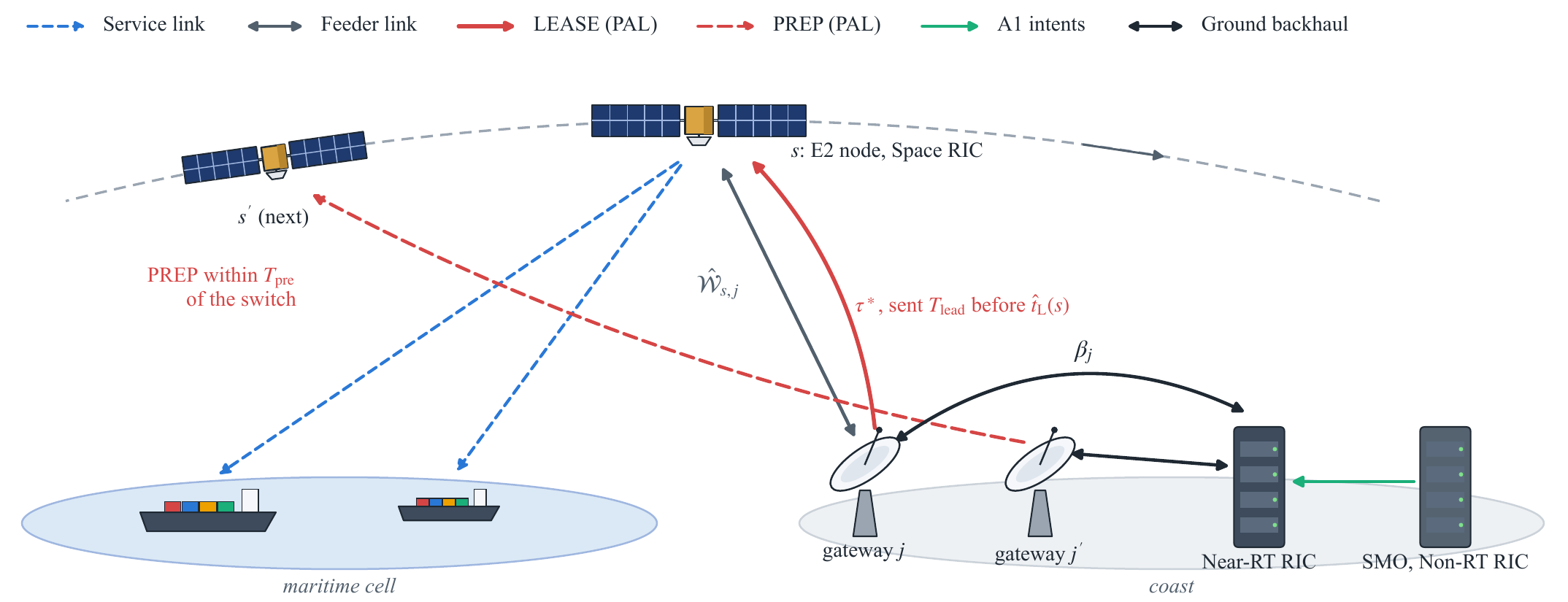
Where a RAN Intelligent Controller sits decides how stale its view is when a decision lands, and whether a satellite can still act when its feeder link is down. oran-ntn makes this measurable. An NR NTN cell on an SGP4 orbit, built by the ntn-traffic helper, supplies per-UE SINR and TBLER that are packed into E2SM-KPM indications under 3GPP TS 28.552 names, each row tagged with its provenance. The E2 node sends each indication one feeder delay up to the Near-RT RIC, optionally aligned to the 100 ms RIC tick, and buffers indications during a feeder outage while a Space RIC on the satellite takes over in autonomous mode. xApps decide, a conflict manager resolves contention, and E2SM-RC actions travel back to registered actuators such as a handover trigger or a beam loss model on the live channel. The next KPM report shows whether the action changed the radio.
The module has a real-time RIC tier on the satellite that refuses loop periods of 10 ms or more, A1 policy management with intent leases that fall back to a safe intent, a contact plan, cross-domain SMO analytics (NWDAF, transport path controller), and O-RAN WG4 fronthaul split options 2, 7.2a, 7.2b and 8 checked against the measured feeder delay. Platform classes (UAV, HAP, LEO, MEO, GEO), functional role switching from RU to full gNB, transparent and regenerative payloads after 3GPP TR 38.821, and ONNX-based inference xApps with a heuristic fallback are included. In simulation, E2 is a delay-modeled ns-3 header rather than ASN.1 APER over SCTP, and O1 is not modeled.
Measured numbers
RC actions recorded by five concurrent xApps (7,738 decisions; 71 E2 nodes, 0 conflicts, 0 policy violations)
One run of oran-ntn-full-scenario --duration=600 --numUes=20, seed 1; the RC path records actions without actuating the radio in this scenariop95 decision latency of the Doppler compensation xApp (4,272 decisions, 68,489 actions); xApp computation only, not the end-to-end loop
Same oran-ntn-full-scenario run as aboveSize of the core oran-ntn test suite (RIC, service models, A1, Space RIC)
./test.py -s oran-ntnEach number states the run it comes from; the README of the module lists the command that reproduces it.
Standards it follows
| O-RAN E2AP | E2 setup, indications and control between E2 nodes and the RIC |
| O-RAN E2SM-KPM | KPI indications built from measured per-UE SINR and TBLER |
| O-RAN E2SM-RC (including Style 3) | Control actions such as BEAM_SWITCH and HANDOVER_TRIGGER |
| O-RAN E2SM-CCC | Service model behind the service model registry |
| O-RAN A1 policy | Policy types with versioning, acknowledgement and intent leasing |
| O-RAN WG2 and WG3 architecture | Non-RT and Near-RT RIC architecture and conflict mitigation |
| O-RAN WG4 | Fronthaul split options (with 3GPP TR 38.801) |
| 3GPP TS 28.552 | KPM measurement names |
| 3GPP TS 38.331 | Reconfiguration with sync |
| 3GPP TS 38.413 and TS 38.423 | Named among the RAN interface specifications the module follows |
| 3GPP TR 38.821 | Transparent and regenerative payloads |
| 3GPP TS 38.214 | Named among the physical-layer procedures the module follows |
| ETSI EN 302 307-1 | DVB-S2 MODCOD |
New on 6g-ntn.live
The toolkit now runs in the browser at 6g-ntn.live: pick an example of oran-ntn or any other module, change its parameters, and the real ns-3 binary runs on the server.
Type ./ns3 run with your own arguments; the real binary runs on the server and streams its output.
Open →115 runnable examplesEvery example of the 14 modules, each with a typed parameter form and its measured KPIs.
Open →Live 3D globeReal constellations from CelesTrak elements, propagated with SGP4, with their service and feeder links.
Open →Open datasetsEvery finished run becomes a dataset under CC BY 4.0, with its provenance and configuration.
Open →Validation690 test cases in 41 toolkit suites, and a health check on every example.
Open →Shared scenariosResearchers post a configuration with its parameters and results; anyone can rerun it.
Open →Watch
Watch on YouTube: the NTN Control Center running and visualizing the toolkit examples, in five minutes.
Install
Every module ships in the ready-built container image of the toolkit (version 3.0.1):
docker pull uzairdocker69/ns3-ntn-toolkit:latest
docker run --rm -it uzairdocker69/ns3-ntn-toolkit:latest bash
To build from source, clone ns3-ntn-toolkit, which vendors this module under contrib/, or follow the README of this repository (branch oran-ntn-v4).
Cite
If you use oran-ntn, please cite the toolkit article (doi:10.1109/OJCOMS.2026.3745010):
@article{uzair2026ns3ntntoolkit,
  author  = {Uzair, Muhammad and Aldahlan, Bassma G. and Albar, Ali A. and
             Althumali, Huda and Alghammas, Adnan},
  title   = {ns3-ntn-toolkit: An Integrated ns-3 Platform for 6G
             Non-Terrestrial Networks},
  journal = {IEEE Open Journal of the Communications Society},
  volume  = {7},
  pages   = {13440--13467},
  year    = {2026},
  doi     = {10.1109/OJCOMS.2026.3745010}
}