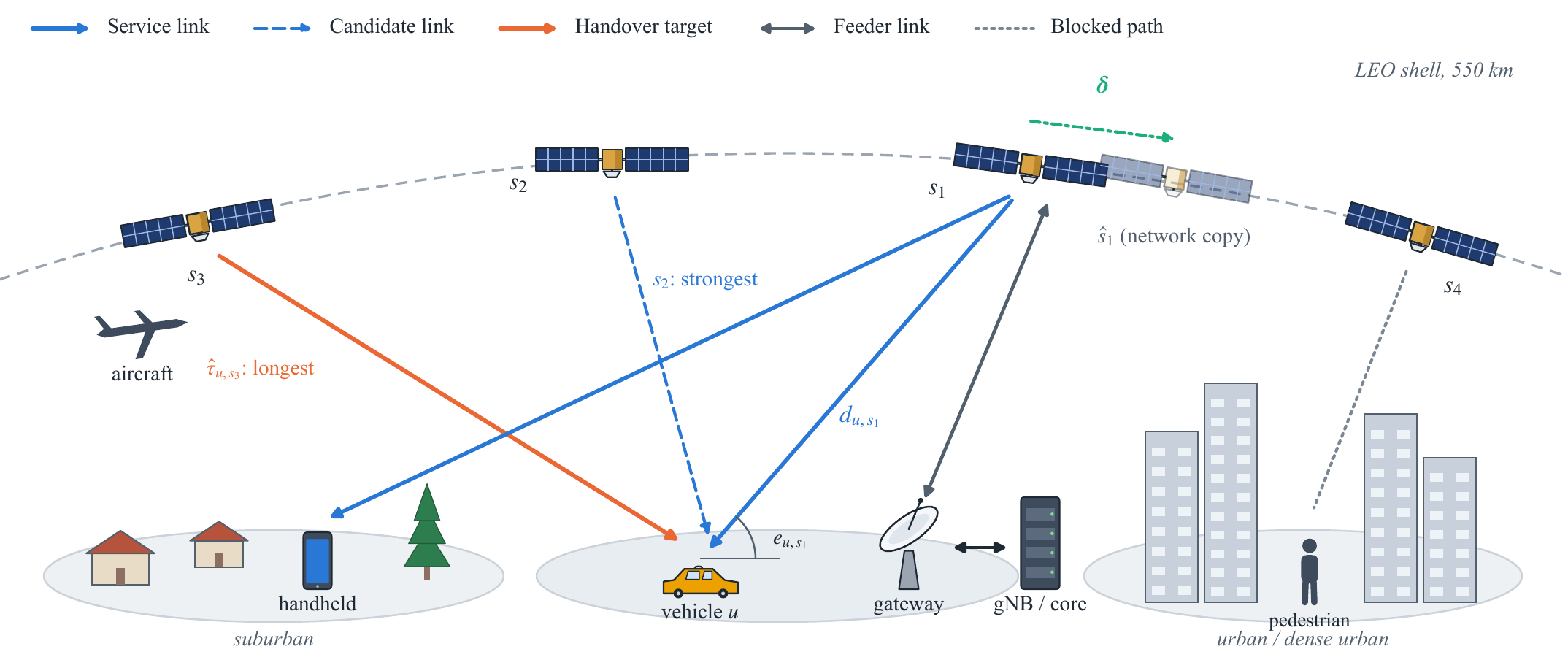
What ntn-cho-framework does
ntn-cho is an ns-3 module for conditional handover (CHO) in LEO non-terrestrial networks that estimates each candidate satellite's time to exit from propagated orbits and conditions the handover decision on it. It also implements the 3GPP TS 38.331 CondEvent A3, D1, T1 and Rel-18 D2 triggers, plus elevation and timing-advance mechanisms from TR 38.821, each evaluated against live geometry.
Accompanying studyConditional Handover in LEO Satellite Networks Under Ephemeris Error: Handover-Rate Analysis and Exit-Error Propagation. Code and data are in this repository.
What it models
A LEO cell moves away from its users, so the neighbor that looks best now may be about to set. ntn-cho estimates time to exit (TTE), how long a candidate remains serviceable, by a coarse forward scan over the propagated orbit followed by a binary search for the beam-exit instant. With a line-of-sight probability table it also returns the expected usable time to exit, and it propagates an injected RTN ephemeris error into a first-order sigma of the exit time. The Rel-17 CHO state machine runs from idle through preparation, condition monitoring and execution to completion. Its trigger classes are 3GPP TS 38.331 CondEvent A3, D1 on a fixed reference location, T1 on an absolute window, Rel-18 D2 on a moving ephemeris reference (Section 5.5.4.15a), elevation and timing advance as studied in 3GPP TR 38.821, TTE-aware selection, Rel-19 conditional LTM and trajectory-predictive CHO, with optional RACH-less execution from timing-advance pre-compensation.
UEs move according to the 3GPP TR 38.811 Section 6.1.1.1 classes (handheld, pedestrian, vehicular, HST, maritime, aviation, fixed IoT) in ECEF, and a measurement model gives TR 38.811 RSRP, SINR and signed Doppler. In the real-stack examples the algorithm decides on the measured SINR of an NR NTN cell. CHO is modeled at the decision and timing level: there is no over-the-air conditional reconfiguration PDU, and the RACH interruption is priced as slant round trip plus processing. Trigger-decided and fallback-decided handovers are counted separately, so the CHO layer is not credited with a cell change the radio would have made anyway.
Measured numbers
Handovers per run of the TTE-aware policy (A3 RSRP baseline: 463.3 ± 47.8)
ntn-cho-full-constellation, ten seeds per policy, 66 satellites (6 planes x 11) at 780 km and 86.4 deg, 30 UEs, 600 s, suburban; Student-t 95 % half-width; runs from April 2026 that predate later fixes to the moduleHandover success of the TTE-aware policy, with 0.00 % ping-pong
Same ten-seed ntn-cho-full-constellation runs as aboveHandover success of location-based (D1) CHO, with 57.07 ± 3.26 % ping-pong
Same ten-seed ntn-cho-full-constellation runs as aboveHandover success of the A3 RSRP baseline, with 50.23 ± 2.51 % ping-pong
Same ten-seed ntn-cho-full-constellation runs as aboveFiring times of D2 and TA / D1 / A3 / T1 / elevation triggers
Shipped two-cell pass; elevation fired when the serving satellite reached the 10 degree floorSlant range at 10 deg elevation checked by the ntn-standards-validation suite
LEO-600 (TR 38.821 reference), spherical-Earth elevation and slant relationEach number states the run it comes from; the README of the module lists the command that reproduces it.
Standards it follows
| 3GPP TS 38.331 | Conditional reconfiguration and CondEvent A3, A4, D1, D2, T1; SIB19 |
| 3GPP TS 38.300 | Handover procedure |
| 3GPP TS 38.133 | Measurement |
| 3GPP TS 38.321 | Random access |
| 3GPP TR 38.821 | NTN mobility, interruption budget, Set-1; elevation and timing-advance mechanisms as study items |
| 3GPP TR 38.811 | UE mobility classes (Section 6.1.1.1) and NTN channel scenarios for RSRP and SINR |
New on 6g-ntn.live
The toolkit now runs in the browser at 6g-ntn.live: pick an example of ntn-cho-framework or any other module, change its parameters, and the real ns-3 binary runs on the server.
Type ./ns3 run with your own arguments; the real binary runs on the server and streams its output.
Open →115 runnable examplesEvery example of the 14 modules, each with a typed parameter form and its measured KPIs.
Open →Live 3D globeReal constellations from CelesTrak elements, propagated with SGP4, with their service and feeder links.
Open →Open datasetsEvery finished run becomes a dataset under CC BY 4.0, with its provenance and configuration.
Open →Validation690 test cases in 41 toolkit suites, and a health check on every example.
Open →Shared scenariosResearchers post a configuration with its parameters and results; anyone can rerun it.
Open →Watch
Watch on YouTube: the NTN Control Center running and visualizing the toolkit examples, in five minutes.
Install
Every module ships in the ready-built container image of the toolkit (version 3.0.1):
docker pull uzairdocker69/ns3-ntn-toolkit:latest
docker run --rm -it uzairdocker69/ns3-ntn-toolkit:latest bash
To build from source, clone ns3-ntn-toolkit, which vendors this module under contrib/, or follow the README of this repository (branch ntn-cho-v4).
Cite
If you use ntn-cho-framework, please cite the toolkit article (doi:10.1109/OJCOMS.2026.3745010):
@article{uzair2026ns3ntntoolkit,
  author  = {Uzair, Muhammad and Aldahlan, Bassma G. and Albar, Ali A. and
             Althumali, Huda and Alghammas, Adnan},
  title   = {ns3-ntn-toolkit: An Integrated ns-3 Platform for 6G
             Non-Terrestrial Networks},
  journal = {IEEE Open Journal of the Communications Society},
  volume  = {7},
  pages   = {13440--13467},
  year    = {2026},
  doi     = {10.1109/OJCOMS.2026.3745010}
}